by Kegorapetse | Jun 26, 2019 | SMU Media
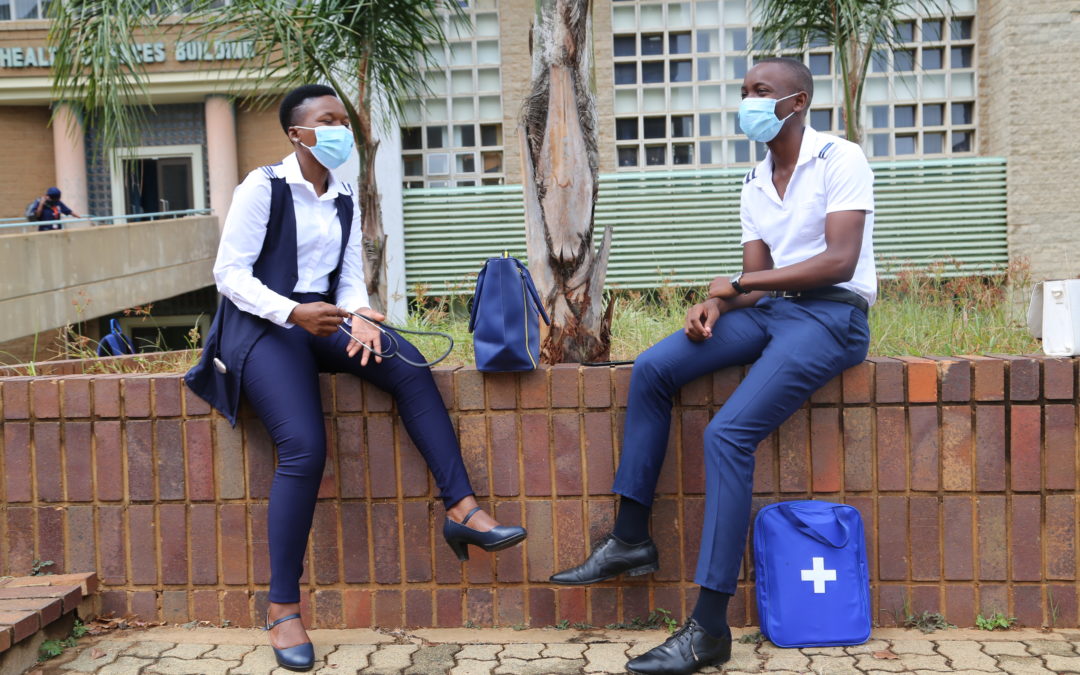
SMU Students, Mr. Thulani Motha and Ms. Rendani Tshilambwana were recently elected as President and Media & Communication Officers, of South African Pharmaceutical Students Federation (SAPSF) Presidential Committee, respectively. The two SMU students, along with other members of the committee have a mandate of uniting all pharmacy students in South Africa through provision of leadership, addressing the student’s needs and improving their standing and recognition within the health care fraternity.
Motha is a Master of Pharmacy Student specialising in Public Health Pharmacy & Management, while Tshilambwana is a third year student in Pharmacy. Their plans for the federation to serve their constituency. As the incoming president, Motha said he would prioritise addressing the challenges faced by the graduates when seeking internship and community service placement. “Collectively with other members of the committee, I will strive for placement of graduates into the industry. Currently we have a challenge of graduates unable to get internship placement. That issue will be addressed quickly with all relevant stakeholders to have a mutual understanding when it comes to solutions,” said Motha.
As the incumbent of the Media and Communication portfolio, Ms. Tshilambwana envisions taking the federation’s communication division to greater heights. “Under my leadership, the media and communication division will engage pharmacy students on various health care topics that will enhance our knowledge”, she said.
By Tumelo Moila
by Kegorapetse | Jun 18, 2019 | SMU Media
Mr. Sebastian Grimm a fifth year student from the Medical University of Vienna in Austria arrived in South Africa to do an elective at the Sefako Makgatho Health Sciences University. His elective was spread over three months, with his first month spent in Psychiatry, the second and third months in Paediatrics, as well as Anaesthesiology in that order.
In these three months spent in the country, he came into contact and worked with psychiatric patients at the Weskoppies Psychiatric Hospital where he got acquainted to bipolar, schizophrenia and depression cases.
While based at the Paediatric ward at the Dr. George Mukhari Academic Hospital where his focus was now on children presenting with Tuberculosis (TB) and HIV, working with other students, Mr. Grimm was able to amongst other things prepare briefing notes to doctors. Furthermore, the student was also exposed to young patients with heart conditions.
Remarking on his whole experience he said, “the whole elective programme was awesome. It was very interesting to observe how operations are carried out in South Africa. The doctors are well trained to deal with all kinds of emergencies. They do not let inadequate facilites discourage them. They always know how to make up for such inadequacies. They are well rounded and resourceful professionals”, emphasized Grimm.
Grimm said that he was very grateful for the opportunity afforded him to have professional interactions with the patients who confided in him about their health issues. As he prepared to leave, he thanked the staff and students of SMU who were very warm and helpful to him, as a foreign student. The perceptions he had that South Africa is unsafe have been debunked and that is the message he will spread in his country Germany.

by Kegorapetse | Jun 16, 2019 | All News, Opinions
This year marks 43 years since the events of 16 June 1976. As the country observes this historic milestone since the youth of South Africa in particular students took to the streets to voice their displeasure and concerns with the introduction of Afrikaans as a single medium of instruction, a lot has certainly changed in the country’s education landscape.
 The heroic deeds of the students of 1976 have undoubtedly helped accelerate the tempo towards the realization of freedom, as thousands fled the country to join liberation movements in exile and many losing their lives in the process. It is important to note that these activities of 1976 were in the main coordinated by young people.
Fast forward to the post liberation and democratic period, the landscape in education has significantly changed in South Africa with students scoring some victories.
Some Universities have habitually been the preserve of a few in particular those who could afford the exorbitant fees charged by the various institutions. Nonetheless, the goal posts have indeed shifted as more and more young people currently find themselves in the higher education system, even those who are so poor or previously disadvantaged. This has been made possible of course by the intercession made by government to change the lives of the people through progressive policies that seek to redress the imbalances of the past.
In an effort to further increase access to these institutions, government has effectively over the years made money available through the NSFAS to help those whose families cannot afford to pay for their education.
One can argue that today, institutions of higher learning are indeed the epicenter of the struggle as more and more students call for access, quality free higher education, transformation, decolonization of the curriculum, better infrastructure, intersectionality matters, the demise of apartheid symbols, insourcing of workers etc.
The activities of the fallist movements as characterized by the Rhodes must fall and the recent #FeesMustFall have captured the imagination of the nation and altered the higher education landscape perhaps for the benefit of generations to come in a manner unprecedented and scoring victories in the process.
Today, Institutions of higher learning, government as well as students and other key stakeholders continue to grapple with ways and means of ensuring that access to higher education is fully realized.
The management of Universities across the board are now dealing with new and emerging challenges as a result of more numbers competing to gain access to these institutions while funding from government has been dwindling over the years. This means that while doors are opening, there is no adequate space and infrastructure to accommodate every student especially in public universities.
Additionally, there appear to be concerns about maintaining the quality of the research output, quality of teaching and learning across universities as well as holding on to experienced and eminent academics while at the same time ensuring that the numbers of student enrollments increase. It is indeed a tightrope to walk as many strive to strike a balance and ensuring that the standing of their universities is safeguarded as well as improving and maintaining the high quality of graduates produced.
Sefako Makgatho Health Sciences University is undoubtedly playing its part to ensure through its five schools that quality health sciences professionals are nurtured and produced for the benefit of the country.
SMU is arguably better positioned to provide solutions to the health challenges facing the country through its graduates and research efforts. Furthermore, through its community service programs, the University students are already making a meaningful contribution to the wellbeing of citizens working under strict supervision.
In remembering the generation of 1976, one can without any shadow of doubt proclaim that their relentless fight in pursuit of equal access to education, and their acts of valor were not at all in vain. Their heroic deeds paved the way for the current and future generations to complete what they started. However, there is still a lot to be done to adequately address emerging challenges and demands.
Phaladi Seakgwe is SMU Communication Manager. Writing in his personal capacity.

by Kegorapetse | Jun 10, 2019 | All News, Opinions
SMU is today hosting international visitors from the University of Nottingham – a UK based institution to crystallize the collaboration between the two Universities on Gender Based Violence issues.
 Deputy Minister in the Presidency responsible for Women, Youth and People with Disabilities Professor Hlengiwe Mkhize lauded both institutions for the initiative.
In her address to those present, Prof Mkhize emphasised the need for collaborations among institutions as they serve as critical agencies of change. She further said that as a country, South Africa has done a lot of work in ensuring that progressive legislations are in place to deal with the scourge of Gender Based Violence, however decried the continuous presence of cases of date rape affecting young women in particular students as well as corrective rape mainly experienced by members of the LGBTQI community.
She further denounced the rising numbers of femicide and called for action by law enforcement agencies and encouraged victims to report the cases. ” A number of parents have lost their daughters in the hands of their lovers. In most cases evidence based information is required to successfully deal with such instances and I want to encourage institutions to get this right through research initiatives and understanding the dynamics of social phenomena as this will greatly help society”, said the Deputy Minister.
Speaking on behalf of the University, the Deputy Vice Chancellor responsible for Research Prof Ayo-Yusuf thanked the University of Nottingham for choosing SMU. He said collaborations are mutually dependent and appealed to more international partners to walk with SMU to make an impact in society.
The international visitors are hosted by the University Nursing Department and will be with the University until 12 July 2019.
By Phaladi Seakgwe

by Kegorapetse | Jun 7, 2019 | SMU Media
The 2019 graduation ceremonies of the SMU stood out as one of the most celebrated highlights in the university’s five year history due to the high number of students who obtained their degrees cum laude and overcoming of the odds.
A record of 30 students ascended the stage and were awarded their degrees with distinctions. The students were from the School of Science and Technology, the School of Medicine and the School of Pharmacy. The glory was not only savored by those who obtained outstanding marks in their studies, but also by those who persevered and overcame serious physical and psychological challenges, in their studies.
Ms. Tsholofelo Mtshweni, who was born with bilateral mild to profound Sensory-Neural Hearing Loss (SNHL) was one such student. She registered for a Bachelor of Speech, Language, Audiology, Pathology (BSLAP), in 2013. In her third year, she was diagnosed with SNHL. Suffering from SNHL, she experiences problems with the translation of theoretical knowledge into practice because the hearing loss worsened to an extent of affecting her speech recognition abilities. She, subsequently, lost her ability to pronounce some sounds and words properly.
Unable to pronounce some sounds and words properly as a BSLPA student was not going to augur well for her because the profession deals with hearing impairment, language, speech and articulation disorders. So, the lecturers intervened and convinced her and her parents to discontinue BSLAP studies and register afresh for Bachelor of Pharmacy (B.Pharm). Her heart was broken as she had to start all over again. With the love of her family, the mentorship of Ms. Lindi Zikalala, her lecturer and support of friends, she persisted and completed her B.Pharm degree in 2019.
The other graduate who experienced psychological challenges was Dr Sandile Ndlovu. Having completed a Bachelor of Science (BSc) in record time, he registered at SMU for Bachelor of Medicine and Bachelor of Surgery (MBChB), in 2001. In the course of his MBChB studies, he suffered from a depressive illness and consequently discontinued his studies. Having spent some time on treatment, he obtained a medical clearance which was a mandatory requirement for him to be readmitted to continue with his studies. He was ably mentored by Prof. Pindile Mntla, Head of the Department of Cardiology and Ms. Angie Malope, the Academic Coordinator, who was his social and emotional mentor. Ndlovu completed his studies and graduated in 2019.
Dr. Ananias Kgopa, a Lecturer in the Department of Biochemistry, established a Tissue-Culture and Molecular Biology Laboratory for Honours, Masters and PhD students, at SMU. Dr. Kgopa built the laboratory anew as the university did not have one. The Laboratory focuses on Cancer and Diabetes research, using tissue culture to explore the impact of traditional medicine on the management of Diabetes and Cancer.