by Kegorapetse | Oct 31, 2019 | SMU Media
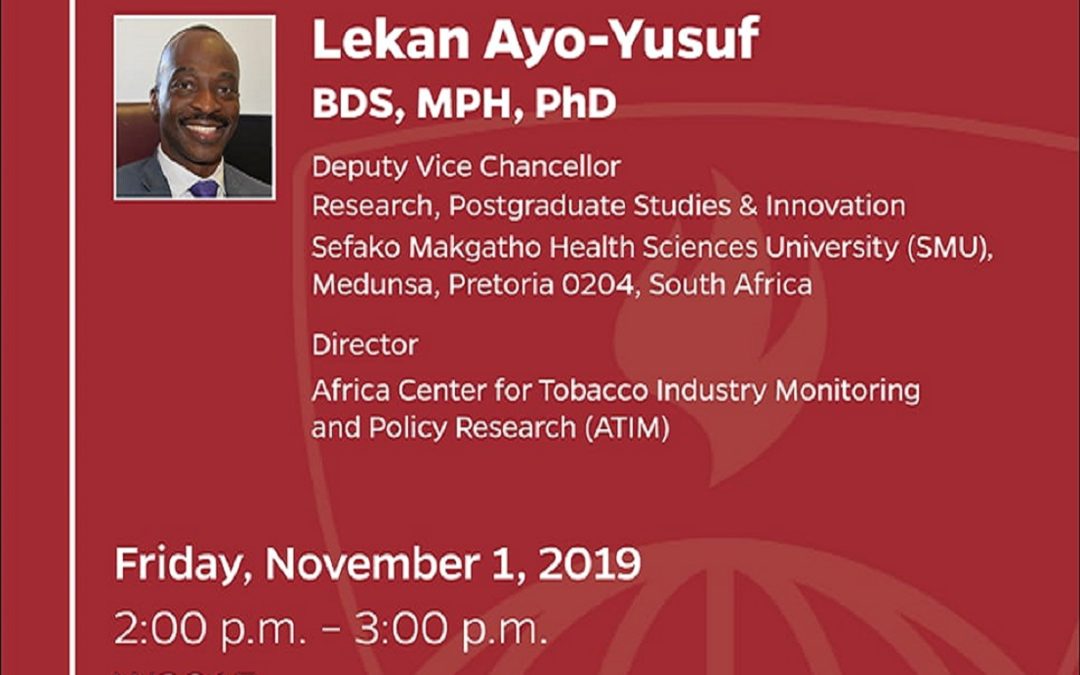
Prof O Ayo-Yusuf, Vice-Chancellor (Acting), will be delivering a Presentation on Friday, 01 November 2019, under the Theme “Tobacco Control in South Africa – The Challenge of Elicit Trade and Industry Interference.” He also gave presentation at Harvard and NYU School of Medicine.
by Kegorapetse | Oct 16, 2019 | SMU Media
The Department of Cardiology (DoC) recently presented a very stimulating refresher course for health workers, at the Council for Scientific and Industrial Research (CSIR) International Convention Centre. The event was attended by a number of General practitioners, majority of whom were Sefako Makgatho Health Sciences University graduates.
By attending the refresher course, the general practitioners are fulfilling their professional obligations as members of the Health Professions Council of South Africa (HPCSA) as they are required to participate in continuous development programmes offered by HPCSA accredited providers. For participating in the refresher course, the general practitioners individually earned 25 CPD Points and certificates of attendance, which will serve as proof that they are complying with the HPCSA prescripts.
They had an opportunity to brush up on their clinical skills and keep abreast of latest medical trends. The topics that the many experts presented on, were very wide ranging – from managing diabetes, haematological emergencies, obstetrics emergencies, hypertension in pregnancy, managing psychiatry patients, TB/HIV management, managing poisoning, heart failure update, to mention a few.
The topic, “Does size matter” which was presented by Prof Etienne Kok, the Urologist, stole the show. He handled this controversial topic so well, with a lot of satire, and had the captive audience absolutely in stitches, his presentation lasted for an hour.
The topics covered were initially identified by the general practitioners. They put forward their topic proposals and the DoC, on its part, had the honour to identify suitable speakers and invited them to come to present at the refresher course.
‘‘The refresher course is very good for us to attend because we are actually refreshing on what we learnt as MBChB students and being kept abreast of latest developments. There is a lot of research which is being conducted from which we are able to learn about latest research which enables us to manage our patients better. It is a chance to learn more. As General practitioners, we are the first pot of call for our patients,” said Dr Sibongile Nzuza, who graduated in 1991 with a Bachelor of Medicine and Bachelor of Surgery (MBChB) graduate aid.
As the majority of those who attended were SMU alumni, it was also an opportunity for former classmates and friends to reconnect, to reminisce about their time at the university, the highlights and low lights.
By Maditsi Matlala
by Kegorapetse | Sep 6, 2019 | SMU Media
In the interest of ongoing professional development, Dr Tshimane Tshepuwane, in the department of Obstetrics and Gynaecology (DOG), along with SINAPI Biomedical, extended a joint invitation to Professor Gerhard Theron, to deliver a lecture on the use of the Ellavi Uterine Balloon Tamponade (Ellavi UBT).
A new device, Ellavi UBT became commercially available in the 3rd quarter of 2019 and it is being used to prevent child birth bleeding complications which results in the deaths of mothers. It is based on the glove balloon used in South Africa since 2008. Prof Gerhard Theron also described the Ellavi UBT in the Postpartum Haemorrhage Monograph published in 2010 by the National Committee for Confidential Enquiries into Maternal Deaths. This inventor, from the University of Stellenbosch, is a leading light in obstetrics and gynaecology, with many awards and many articles in peer review journals, to his name.
Watched by a captive audience of representatives of professional midwifery nurses, post-natal nurses, registrars, consultants, fourth year to final year Bachelor of Medicine and Bachelor of Surgery (MBChB) students, Theron meticulously demonstrated how to operate the Ellavi UBT.
Thereafter he gave a select group of consultants, registrars and professional midwives an opportunity to put into practice what they had learned in order to enable them to sharpen their newly acquired clinical skills.
Impressed with the Ellavi UBT and the ease with which the select group operated the device, Professor Sam Monokoane, the head of the DOG at SMU, expressed his wish to phase it in, at the Dr George Mukhari Academic Hospital, where students fulfil their clinical obligations.
On state tender the SOS Bakri costs R4800 per unit whilst the Ellavi UBT is R150 per unit for public hospitals. It is not on state tender, presently. The Ellavi UBT is affordable for use in resource poor settings.
Already, all hospitals in the three rural regions of the Western Cape Province, and half of the metropolitan areas of Cape Town served by Tygerberg Hospital as a referral hospital, are using Ellavi UBTs since the 1st quarter of 2019. Though no data is available regarding lives saved with Ellavi UBT.
About 90 papers published in peer reviewed scientific journals do report a success rate of 87% of the Ellavi UTB if used for the correct indications. A decline in death rates due to child birth bleeding complications following Caesarean births is to be expected if Ellavi UBT is to be used in all birthing facilities in South Africa.
By Maditsi Matlala
by Kegorapetse | Jul 26, 2019 | All News, SMU Media
President Cyril Ramaphosa has signed the much anticipated Presidential Health Compact during a ceremony held at the Dr George Mukhari Academic Hospital on 25 July 2019. Joined by the Minister of Health Dr Zweli Mkhize and other key role players in the health sector, Ramaphosa lauded the signing of the health compact and said it heralds a new dawn for the people of South Africa as it will ensure one country, one health system.
“The signing of the Presidential Health Compact is the culmination of a long journey we have traveled together since we convened the Presidential Health Summit last year to find solutions to the crisis facing our health system”, emphasised the President.
The health summit aptly characterized the health situation in the country to be in a state of crisis.
“It is fitting that we are signing this historic accord here at the Dr George Mukhari Academic Hospital where a groundbreaking and difficult operation to separate conjoined twins was performed in 2017 in collaboration with staff from the Nelson Mandela Children’s hospital and a number of private sector doctors”, said President Ramaphosa.
He further stated that the successful completion of the operation cemented the good reputation of so many of the public hospitals that goes unrecognized.
The President further reminded those who attended that the hospital is also the teaching facility for the Sefako Makgatho Health Sciences University, the first health sciences University established in post- apartheid South Africa.
“The Sefako Makgatho University campus was once the campus of the Medical University of South Africa known as Medunsa.
More than half of all African medical doctors and dentists in Southern Africa were trained at Medunsa, and no doubt many of them are among us today”, he continued.
Additionally, President Ramaphosa paid tribute to those who walked through the doors of Medunsa(now SMU) for having been trail blazers and paving the way for the young professionals who now continue to make a difference in the lives of the citizens. The health compact has identified nine(9) pillars that require to be strengthed to improve the health system in the country. They are as follows :
1. Augment human resources
2. Ensure improved access to essential medicines, vaccines and medical products through better management
3. Execute the infrastructure plan to ensure adequate, appropriately distributed and well maintained health facilities
4. Engaging the private sector in improving the access, coverage and quality of health services
5. Improve the quality, safety and quantity of health services provided with a focus to primary health care.
6. Improve the efficiency of public sector financial management systems and processes.
7. Strengthen governance and leadership to improve oversight, accountability and systems performance at all levels.
8. Engage and empower the community to ensure adequate and appropriate community based care
9. Develop an information system that will guide the health system policies, strategies and investment.
By Phaladi Seakgwe

by Kegorapetse | Jul 23, 2019 | Research, SMU Media
The Health and Welfare SETA, invite applications from registered employed (part-time), and unemployed (full-time) South African students pursuing Postgraduate Diploma/Honours/B-Tech, M-Tech/Masters, D-Tech/Doctoral and Post-Doctoral studies at South African universities and other accredited higher education and training institutions.
While other areas of study within the sector will be considered; preference will be given to majors / streams and research focus that fall within the following priority areas:
- Veterinary Sciences, Marine Aquaculture and Marine biology
- Nursing Sciences focus – Nursing Education, Health Professions Education, Mental Health Nursing, Maternal and Child Health, Community Health Nursing, Rural Health, and Primary Health Care;
- Social Work focus – Social Health Care, Occupational Social Work and Social Work (in Forensic Practice); Clinical Social Work, Child Protection Law and Play Therapy.
- Psychology focus – Counseling, Clinical, Forensic, Educational, and Community,
- Public Health focus – Clinical Epidemiology, Health Economics, Health Systems (Policy, Planning & Management), Medical Informatics, eHealth, Telemedicine, Biostatistics, Bioethics and Health Law (Medical Law);
- Mental Health focus – Forensic Mental health, Child-Adolescent and Adult Psychiatry, Public Mental Health and Community Psychiatry,
- Health sciences focus – Radiography, Audiology, Speech Language Therapy, Pharmacy, Optometry, Dentistry, and Physiotherapy,
- Medical Sociology, Environmental Sociology, Demography and Population studies;
- Environmental Health/Biology/Chemistry and Occupational Health and Safety;
- Social Welfare focus – Child and Youth Care, Social Services and Development, Poverty and Inequality, Disability care – Rehabilitation and Management,
A special consideration will be given to Honours students undertaking programmes, which will lead to scarce skills specializations, professional registration and licensing. Students with disabilities are encouraged to apply.
Application process: Interested students must complete (type text by using Word) and sign an HWSETA postgraduate bursary application form attached, and submit in a pdf format no later than 26 July 2019. The application must include a proof of registration (a university stamped copy), draft research proposal (where applicable), motivation letter (1 page), required proposed budget (itemized) to complete the research project and a clear certified copy of the South African Identify Document.
Applications must be submitted via email to:jadah.matentji@smu.ac.za.
Enquiries may be directed to Ms. Jadah Matentji at jadah.matentji@smu.ac.za
