Three postgraduate students in Mathematics and Applied Mathematics from Sefako Makgatho Health Sciences University (SMU)—Sanele Mlotshwa, Zakhele Magagula and Siphelele Mbangutha—recently took part in the 17th Annual Workshop on Computational Mathematics and Modelling (WOCCOM2025), held at the University of KwaZulu-Natal (UKZN), Pietermaritzburg Campus.
 Hosted by the Mathematics Discipline within UKZN’s School of Mathematics, Statistics and Computer Science, the workshop convened academics, researchers, and students from across Southern Africa. Delegates hailed from countries including South Africa, Zimbabwe, Botswana, and Eswatini. The workshop focused on applying numerical methods, differential equations, and computational tools to solve real-world challenges in medicine, science, and economics.
Since its inception in 2008, WOCCOM has developed into a leading regional platform for postgraduate academic development, equipping early-career researchers with key skills in applied mathematics and computational science.
Among the workshop’s highlights were keynote and tutorial sessions presented by leading scholars. Professor Sandile Motsa delivered an insightful keynote address titled “Block Hybrid Methods for Systems of Nonlinear BVPs: AI Approach”, showcasing the transformative role of artificial intelligence in solving complex mathematical problems. Dr Vusi Magagula led a compelling tutorial on “Mathematical Modelling of Infectious Diseases”, demonstrating how compartmental models—such as Susceptible-Infected-Recovered (SIR) and Susceptible-Exposed-Infected-Recovered (SEIR)—are used to analyse and predict the spread of disease. Dr Zodwa Makukula chaired one of the plenary sessions, facilitating robust academic discourse and inclusive engagement.
 The SMU trio participated in intensive hands-on training sessions focused on numerical accuracy, convergence, and computational efficiency—key foundations of modern numerical analysis. On the second day, they were tasked with solving real-world modelling challenges, promoting teamwork, critical thinking, and the practical application of concepts.
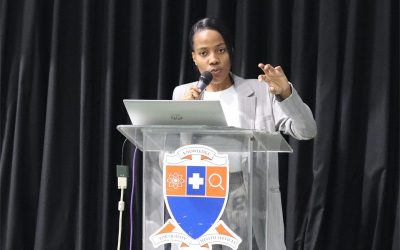
Zakhele made a notable contribution during the workshop’s mini-conference segment. His presentation, “On the Effectiveness of Quarantine as a Measure to Control the Spread of COVID-19 in South Africa: A Mathematical Modelling Perspective”, examined the role of quarantine through the lens of differential equations. His talk attracted interest and valuable feedback from attendees, further strengthening the impact and scope of his research.
Reflecting on the experience, the students described WOCCOM2025 as a transformative academic milestone. “It was more than just a workshop—it was an incubator for ideas, skills, and future collaborations,” said Mbangutha. The trio also established valuable academic connections with peers from UKZN, the University of Eswatini (UNESWA), the University of Johannesburg (UJ), and other institutions—laying the groundwork for future research collaboration.
“The workshop helped us appreciate mathematics as a universal language—one that bridges medicine, economics, and computer science,” remarked Mlotshwa.
Their participation was made possible through the support of the SMU Department of Mathematics and Applied Mathematics, and longstanding WOCCOM sponsors such as the Hanno Rund Fund and the Centre of Excellence in Mathematical and Statistical Sciences (CoE-MaSS).
All three students intend to integrate the knowledge and skills acquired at WOCCOM2025 into their respective doctoral research. “The experience reaffirmed the power of modelling to shape public policy and health outcomes,” Zakhele concluded.
Their message to future SMU students? “Believe in your ability to contribute meaningfully through mathematics. Attend, engage, and let your curiosity guide you.”
By Tumelo Moila