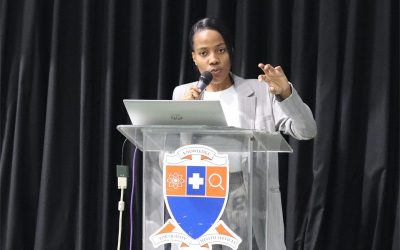
Every day at Sefako Makgatho Health Sciences University (SMU), while future doctors, nurses, and scientists fill lecture halls and hospitals, there is another kind of leadership quietly at work. It is found in the hands that scrub, sweep, and sanitise—the hands that uphold the dignity of the campus and the safety of everyone who enters its gates. Among these is Rachel Molly Thongo, Acting Head of Cleaning Services, whose story represents not just her own but the countless women who sustain campus life through care and service.
 Born in Soshanguve and raised by a single mother, Thongo’s journey to leadership was shaped by resilience, humility, and purpose. “We were raised with love and respect,” she recalls. These values now underpin her management style, where compassion meets accountability, and every task, no matter how routine, is treated as essential.
Her professional story at SMU began in the campus cafeteria under a private catering provider. When SMU insourced its staff, Thongo joined the university officially, later transitioning to the Cleaning Services Department, a move she once resisted but has since embraced with pride. “At first, I struggled to accept it,” she admits. “But then I realised: without cleaning services, nothing else works.”
Today, as Acting Head of the Department, Thongo oversees scheduling, health and safety compliance, and operations across SMU’s expansive campus. Her leadership ensures that learning spaces, residences, and clinical areas remain clean, hygienic, and ready for the university’s daily life to unfold.
“We uphold SMU’s hygiene standards, and that directly supports its public image as a leading health sciences university,” she explains. “Our work keeps students, staff, and patients safe.” But beyond logistics, Thongo’s leadership is human. She believes in nurturing the people who sustain the university’s spaces. “A thank you, a half-day off—small things matter to people who work hard,” she says. Her approach was affirmed when she was selected by SMU’s Skills Development Office to attend supervisory training at the University of the Witwatersrand. “That made me feel seen,” she reflects softly.
Like many women in operational leadership, Thongo navigates daily challenges, from resource constraints to managing team dynamics. Yet, her loyalty to SMU remains firm. “This institution takes care of its people,” she says. “From study benefits to supporting our families—SMU offers more than a job. It offers dignity.”
Her message to other women in service roles is clear: “What we do matters. Without us, the university wouldn’t function.” Thongo’s story is not only her own. It is a tribute to every woman who arrives before dawn and leaves after dark to ensure that SMU remains a place of healing, learning, and progress. Together, they sustain the university—not with titles or accolades, but through their daily, often unseen, acts of care. At SMU, theirs are the hands that sustain campus. And they deserve to be honoured.
By Tumelo Moila