In a moment defined by ambition and possibility, Sefako Makgatho Health Sciences University (SMU) placed its students at the centre of a significant international engagement, welcoming a distinguished French mathematics delegation to campus. The meeting was not a ceremonial exchange, but a dynamic platform where postgraduate students and academics interacted directly with global research leaders. For many students present, the discussions signalled more than collaboration; they represented access to international research networks, joint supervision, academic mobility, and new postgraduate pathways capable of reshaping their scholarly futures.
 The delegation represented the Centre National de la Recherche Scientifique (CNRS), specifically CNRS Mathematics, and engaged in discussions connected to the International Mathematical Sciences Academy (IMSA). These engagements form part of broader strategic collaborations between CNRS and the University of the Witwatersrand (Wits University), aimed at strengthening global research integration through a proposed International Research Laboratory.
Professor Sophie Niang-Dabo, nominated by CNRS Mathematics to serve as Co-Director of the envisaged International Research Laboratory, outlined the scope of opportunity embedded in the proposal. She explained that establishing a CNRS–IMSA International Research Laboratory would create a sustained research ecosystem. For students, this would translate into international co-supervision, doctoral mobility between France and South Africa, structured research exchanges, and participation in collaborative scientific programmes.
She further emphasised inclusivity. Partnerships of this scale, she noted, must widen participation in global research spaces and include institutions that play transformative roles within their national contexts.
Celine Montbellier, International Programme Manager at CNRS Mathematics, elaborated on the structural benefits of the model. The Centre National de la Recherche Scientifique, she explained, establishes International Research Laboratories to ensure long-term collaboration rather than short-term academic visits. Through this framework, postgraduate students may access joint doctoral supervision, research residencies in France, international seminars, and collaborative publications—mechanisms that directly strengthen academic progression.
 At SMU, the delegation was welcomed by Professor Sechene Stanley Gololo, Deputy Dean of the School of Science and Technology, who positioned the engagement within the University’s developmental mission. As a historically disadvantaged institution, he stressed, SMU must be deliberate in leveraging every opportunity presented to it.
Professor Gololo indicated that the University intends to explore and utilise all opportunities introduced by the delegation and, hopefully, exhaust them fully, as they hold immense value for a previously disadvantaged university such as SMU. He underscored that the students present at the meeting were not observers, but primary beneficiaries. Access to international research laboratories, mobility programmes, and joint supervision, he said, has the potential to significantly expand their academic horizons and contribute to equity and advancement.
Providing strategic context, Professor Emeritus Loyiso G. Nongxa, Chairperson of the Interim IMSA Strategy and Steering Committee, reflected on the evolution of the initiative. Over the past eighteen months, sustained engagements with colleagues at the Centre National de la Recherche Scientifique Mathematics have shaped the proposal. Securing mathematical sciences as a pillar of the Wits University–Centre National de la Recherche Scientifique International Research Centre was a deliberate move, and the proposed International Research Laboratory extends that vision through a formal, long-term collaborative structure.
Professor Nongxa highlighted the broader national significance of IMSA, established to broaden the work of the Centre of Excellence for Mathematical and Statistical Sciences and the National Graduate Academy for Mathematical and Statistical Sciences. The creation of the International Research Laboratory, he noted, would elevate South Africa’s global standing in mathematical sciences while strengthening postgraduate development across participating institutions, including SMU.
The programme at SMU was directed by Professor Maggie Aphane, Head of the Department of Mathematics and Applied Mathematics, who linked the collaboration to the University’s health sciences focus. She observed that SMU’s strength lies in the intersection of mathematical theory and health applications, including biostatistics, epidemiological modelling, computational mathematics, and data science.
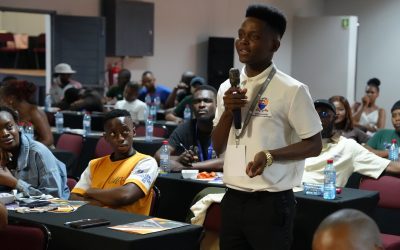
Throughout the engagement, students posed questions about doctoral mobility, research exchanges, and publication opportunities. The dialogue affirmed that the proposed International Research Laboratory is not abstract diplomacy, but a practical framework with direct implications for student growth.
The formal proposal for the Centre National de la Recherche Scientifique–International Mathematical Sciences Academy International Research Laboratory is scheduled for submission by 31 March 2026. While hosted by Wits University, its collaborative architecture is designed to include institutions such as SMU.
By Dimakatso Modise