
Underscoring Sefako Makgatho Health Sciences University’s (SMU) prominence in cutting-edge research, two of its Master of Science (Chemistry) students claimed first and third places in the highly competitive oral presentations at the South African Chemical Institute Northern Section (SACI-NS) Young Chemists’ Symposium. The event, held at the University of Venda, showcased groundbreaking research by Sipho Silotolo and Mbali Moreki, whose projects have wide-reaching implications for agriculture and environmental sustainability.
Silotolo secured first place with his innovative research on tannin reduction in legume seeds, aiming to improve livestock feed efficiency by enhancing nutrient absorption. Moreki earned third place for her pioneering work on the degradation of the pollutant Rhodamine 6G using Zinc Oxide (ZnO) nanoparticles, contributing to advancements in eco-friendly wastewater treatment.
These accolades reinforce SMU’s chemistry department’s growing reputation for producing research that addresses pressing global issues. The symposium, which brought together South Africa’s most promising young chemists, served as a platform for SMU to demonstrate its commitment to academic excellence and the practical applications of science.
Tackling agricultural challenges with cutting-edge chemistry

Sipho Silotolo, SMU Masters’ Student
Silotolo’s research delves into reducing tannins—a significant antinutritive factor in legumes—thereby enabling livestock to absorb more nutrients from their feed. Legumes are a vital protein source, but their natural tannins bind to essential proteins and minerals, hampering livestock health and productivity. Through various processing methods such as soaking, cooking, citric acid infusion, and sodium hydrogen carbonate treatments, Silotolo achieved a remarkable 80% reduction in tannins without sacrificing nutrient content.
“Our goal is to make these methods accessible to small-scale farmers, enabling them to affordably increase livestock productivity,” he explains. His findings promise to improve food security in sub-Saharan Africa by offering sustainable solutions for livestock feed enhancement, showcasing the potential of agricultural innovation to tackle pressing food production challenges.
Reflecting on his win, Silotolo extended heartfelt thanks to his supervisory team and his research colleagues, whose support was instrumental in his success. Overcoming personal obstacles like stage fright, his presentation left a lasting impression on attendees and judges alike, underscoring his dedication and resilience.
Environmental breakthroughs with nanoparticle technology
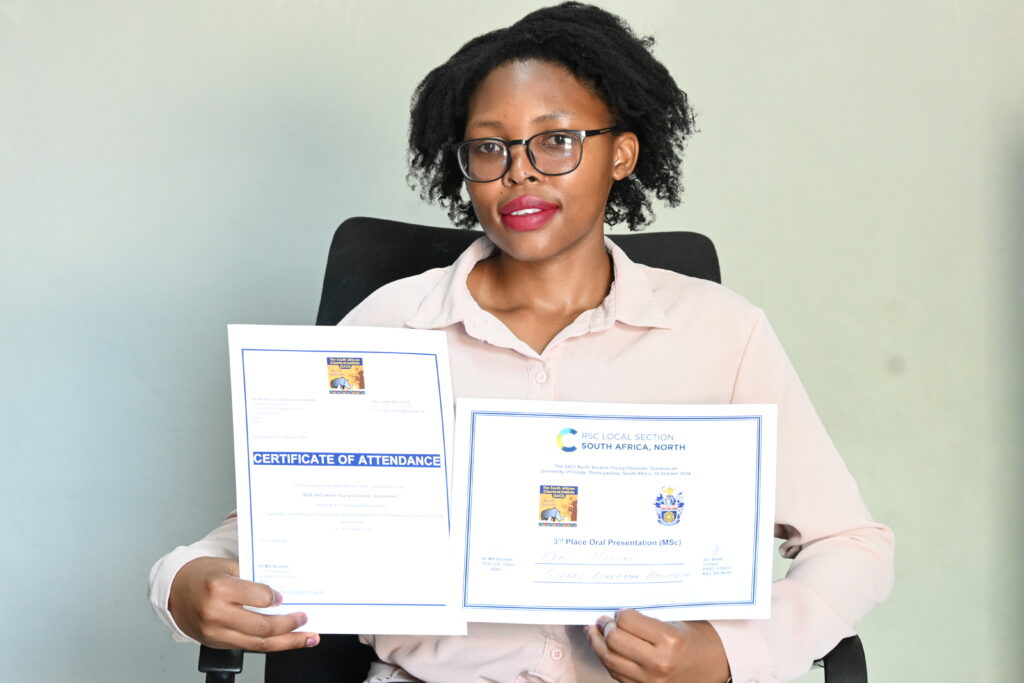
Mbali Moreki, SMU Masters’ Student
Moreki’s research on ZnO nanoparticles presents a novel approach to degrading Rhodamine 6G, a persistent pollutant, in wastewater treatment. ZnO, a relatively benign photocatalyst, has shown significant potential for pollutant degradation under laboratory conditions, yet replicating these results in natural environments has been challenging. The project focused on adapting these conditions for real-world applications, achieving an impressive 88% degradation under neutral pH and visible light.
Her work not only demonstrates the environmental promise of ZnO nanoparticles but also proposes sustainable applications for by-products, such as lactic acid, which can be utilised in food processing. This eco-conscious approach points to a future where water treatment can be more effective and environmentally responsible.
Moreki credited her supervisors for their guidance throughout her preparation, particularly as she took on the role of the final speaker. Her experience underscores the supportive academic environment at SMU, which empowers students to excel even in high-stakes, competitive settings.
Celebrating SMU’s rise in scientific excellence
The awards ceremony, led by Dr Ian Bratt of the Royal Society of Chemistry (RSC SA North), celebrated the exceptional contributions of SMU’s students. The institution’s success in claiming two of the top three positions in the MSc category speaks volumes about its commitment to fostering a research culture that both elevates its students and addresses real-world challenges.
This year’s symposium solidified SMU’s role as a powerhouse in scientific research that benefits communities locally and globally. Through the innovative work of students like Silotolo and Moreki, SMU continues to prove itself as a premier institution in South Africa, positioning itself at the forefront of agricultural and environmental solutions that hold promise for sustainable development.
As SMU’s students lead with purpose and innovation, their achievements are not only a testament to their individual dedication but also a reflection of the university’s unwavering commitment to excellence in scientific research. These accolades strengthen SMU’s growing influence in South Africa’s academic landscape, paving the way for more transformative contributions that will shape the future of science and society.