by Lorato | Oct 15, 2022 | Accolades and Achievements, All News, SMU Media
In a departure from the routine Council workshops, the SMU Council spent considerable time and energy in a strategy reflection workshop from 14 – 15 September 2022 re-imagining a new operating model that
would catapult SMU into the league of World Class Universities, becoming globally competitive and simultaneously remaining locally relevant. The Chairperson of Council Ms. Maria Rambauli emphasized urgency in a shift towards SMU becoming a sustainable self-funded institution, with the academic enterprise at the centre of its operations.
In this context, the university needs to ensure that it attracts excellent academics, professionals, administrative staff and students. It is envisaged that this will ensure that SMU is academically and administratively competitive and becomes the “go to” institution in the HE sector, locally and abroad. The need for collaboration with industry and other institutions of higher learning, and the utilization of alumni for resource mobilization, coupled with an emphasis on impact of SMU initiatives was emphasized. Ms. Thaaniya Isaacs of PwC made a compelling case for the adoption of technology to increase teaching and learning efficiencies in a Health Sciences University. Her presentation was premised on the 2022 PwC survey conducted amongst Vice Chancellors and Deputy Vice Chancellors of the 26 South African public universities.
On transforming SMU into a World Class University, the Vice Chancellor Prof Peter Mbati stated that there has to be a deliberate intent and purpose from within an institution to grow into a world class university while change management towards achieving this goal is key to successful transformation. According to Mbati, the establishment of a World Class university requires, above all, strong leadership, a bold vision of the institution, and clarity of its mission and goals. In this regard, SMU must craft a clearly articulated strategic plan to translate this vision into concrete targets and programmes. Prof. Patrick Demana (former Acting DVC Academic and Research) made a compelling case in his presentation on “Reimagining a World Class Academy at SMU”. This possibility is real, with the need for SMU to expand its PQM, consideration for a hybrid programme delivery model, the need for state-of-the-art infrastructure, striving for teaching excellence, improved rankings and the strengthening of community engagement. On the backdrop of the presentation by the Acting Dean of the School of Oral Health Sciences Prof. Dini Mawela, Council was convinced of the need for strong, principled, cohesive and caring leadership.
In his presentation, the CFO Mr. Eminos Manyawi focused on the new business model as central in achieving financial sustainability. Among others, the model seeks to be increase programme offerings and double student numbers over time, increase infrastructure capacity on campus, improve its third-stream income by amongst others commercialization of SMU land. SMU will consider changes with regard to, amongst others, enrolment targets and its pricing model. The Registrar Dr. Jeffrey Mabelebele led a discussion on the current SMU SWOT analysis while the Chief Operating Officer, Mr. Mfanfikile Sibanyoni presented the status of infrastructure development on campus, and future possibilities.
VCs Desk - SMU Council crafts levers to grow a world class Health Sciences University
File size: 2.06 MB
Created: 15-10-2022
Updated: 15-10-2022
Hits: 357
by Lorato | Jul 12, 2022 | All News, SMU Media
SMU Benchmarking Tour: Engagement with Wits University
Emanating from the salary negotiations, the parties (SMU Management and Organised Labour) agreed to undertake a benchmarking tour with a number of Universities to investigate/explore the following issues to better improve current practices:
a) Salary advances payable
b) Notch progression/ percentiles
c) Medical Aid subsidy
d) Study benefit subsidy on all accredited public and private colleges, universities and higher education institutions
e) Advance on 13th cheque
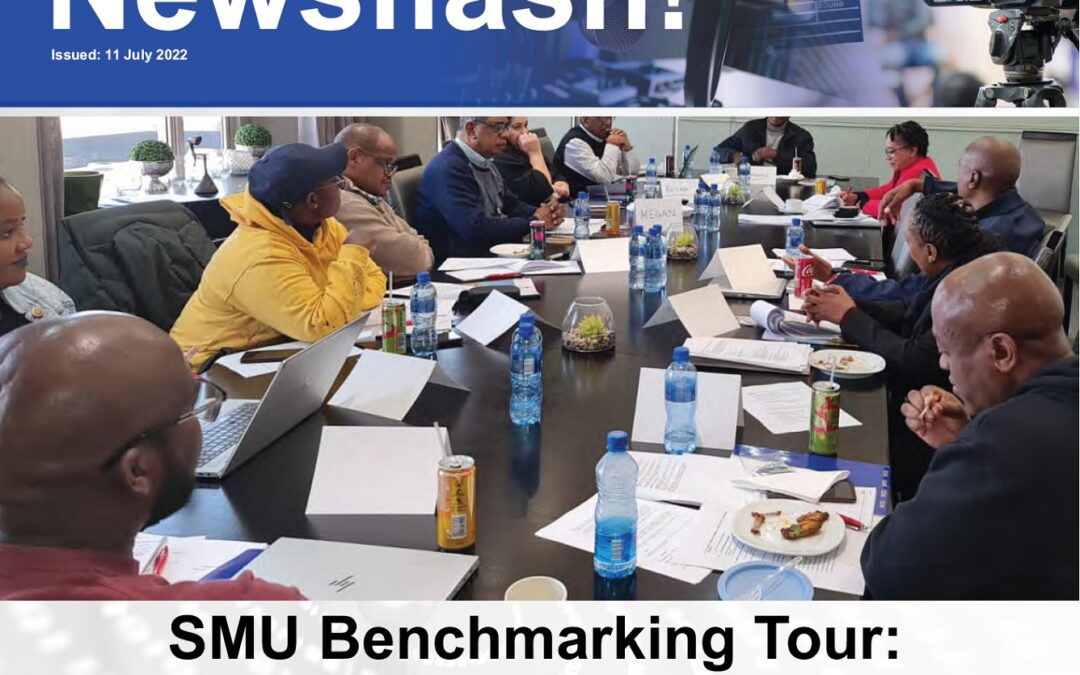
The following SMU delegation, comprising of HR and Organised Labour, met with the HR Team at Wits University on 07 July 2022:
• Odette Ramsingh (Human Resources)
• Pontsho Hlalethwa (Human Resources)
• Kwenze Khuzwayo (Human Resources)
• Tshifhiwa Mulaudzi (NEHAWU)
• Gladys Malema (NEHAWU)
• Jacob Lekabe (APSA/SAPTU Collaboration)
• Kabelo Mokoape (representing APSA/SAPTU Collaboration)
• Lizette Van der Merwe (representing APSA/SAPTU Collaboration)
The SMU delegation appreciated the willingness of Wits University to engage on the various issues that we as SMU are currently wrestling with as we seek solutions that are in the best interest of the employees and the University. Wits University openly shared their information and knowledge with SMU, and the delegation left the engagement with many insights and much ‘food for thought’.
There is no doubt that engagements of this nature will definitely enrich perspectives on policy, practices and approaches, and will impact on the quality of decisions that SMU will take on the matters mentioned. Within this context of learning and growing, it is therefore with excitement that the delegation will engage with the HR Team at the University of Mpumalanga on 28 July 2022.
Once all engagements are concluded, a position paper will be drafted for Executive Management Committee for the necessary direction and decision.
What the joint benchmarking process demonstrates is a commitment by the parties to meaningfully explore the issues, and in an open and transparent manner to seek solutions. What it will also serve to do according to Ms Odette Ramsingh, SD: Human Resources at SMU, ‘is consolidate a continued relationship of knowledge and information sharing between the respective universities that will bode well for embedding better practices in the sector’.
The strategic partnership between SMU Management and Organised Labour was commented upon when a representative from the host University indicated that ‘It was such a pleasure to have hosted a diverse audience; a first I must say where management and organised labour collaborate on such an important goal of benchmarking practices’.
SMU HR and Labor undertakes a tour of Wits University
File size: 966.84 KB
Created: 12-07-2022
Updated: 12-07-2022
Hits: 203
by Lorato | May 31, 2022 | All News, SMU Media
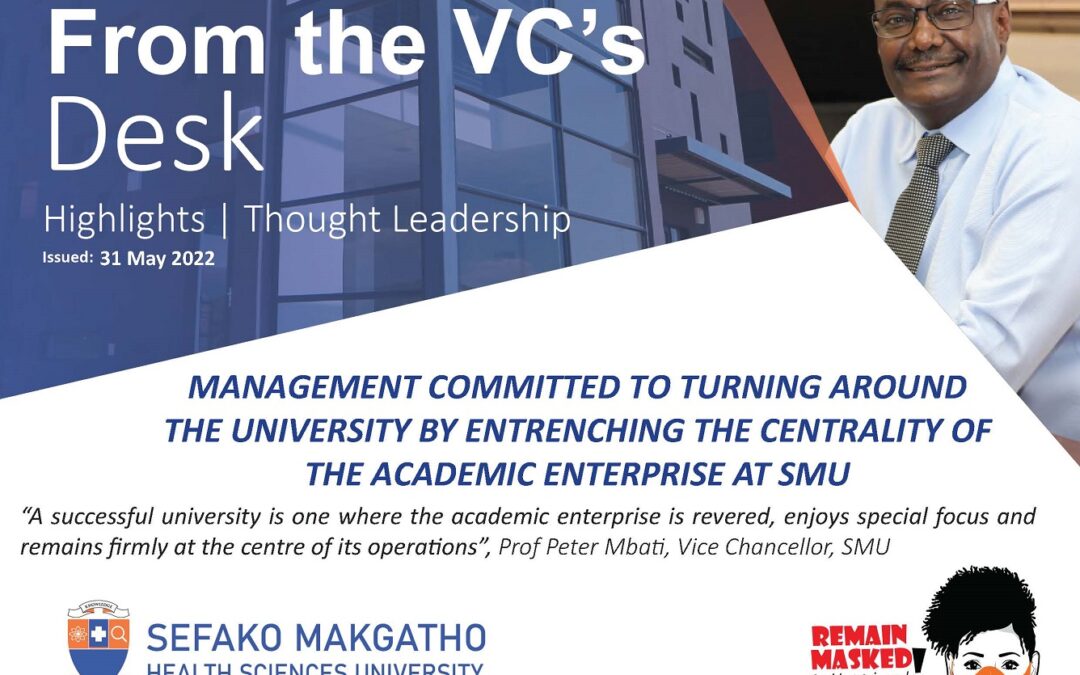
“A successful university is one where the academic enterprise is revered, enjoys special focus and remains firmly at the centre of its operations”, Prof Peter Mbati, Vice Chancellor, SMU
The SMU Senior Management Committee (SMC) is chaired by the Vice Chancellor and is composed of members of the Executive Team, Deans of Schools and Directors of various portfolios. At its meeting held on 25 April 2022, the SMC observed that:
“It is common knowledge that the SMU academic project has not been adequately placed at the centre of what the University does, as the concerns of organized labour and students have arguably often crowded out the requisite support to be, ordinarily, provided to the academic project of the University. As part of the institutional effort and renewal to ensure that the academic project of the university takes centre stage of what the University does through the various stakeholders, academic employees, support staff, students and labour, the Senior Management Committee resolved that a special meeting of the senior management be held to discuss this matter dispassionately”.
As a consequence, a special meeting of the SMC was held on 23 May 2022 to engage on this critical point. A well thought-out presentation by Deans’ of Schools foregrounded critical points that were pivotal to the subject matter, including academic leadership at various levels. The crux was eventually to re-imagine the modus operandi of the academic enterprise in a bid to maximize its efficiency and effectiveness. A high level summary of some of the issues discussed is presented below:
- When does a University cease to be a university? (a series of lectures/dialogues were suggested to unravel the intricacies of this question).
- Politicization of the SMU academic space and its negative impact on the academic project as a whole, and the reputation of the University.
- The implementation of the SMU procurement policy and its unintended consequences on inefficiencies experienced in the broader academic teaching and research environment.
- Standard of service and urgency received from supporting departments.
- Striking a balance between “Corporatization of Universities with more resources towards what is considered non-core business and compliance reporting versus resourcing the academic core functions, including research and innovation.
- Resource allocation and prioritization of the academic project activities in a financially constrained SMU.
- Audit of employee efficiency (are all employees adequately and gainfully employed, and what can be done practically to optimize the overall employee performance?)
- Implementation of the New Business Model and improved third stream income generation.
- Better oversight over infrastructure and maintenance projects, ensuring value for money. Every cent that is saved must be re-directed to the academic project.
- Centralized laboratories (shared laboratories) with state of the art facilities.
- Introduction of peer assessment and student assessment.
- Members of the Executives usurping powers of Deans, re versing decisions of Deans, making Deans and HoDs to look weak in the face of the constituencies they serve, including students.
- Re-definition of the meaning and application of the concept “student-centeredness” and where the academics rules of the universities remain sacrosanct. Balance between allowing student-activism to thrive whilst ensuring student discipline.
- Managers constantly browbeaten by the SRC and organised-labour.
- Line managers at various tiers unable to take appropriate disciplinary action against errant subordinates due to uncertainties concerning firm support from multi-layered superiors.
- Disruptions to the academic project due to incessant protest action by students and organized Labour has serious deleterious impact on the academic progress of our students and the reputation of the University.
- Aligning staffing plan to the new business model.
- Dialogue/discourse series on various difficult topics as we entrench the centrality of the academic enterprise in the fibre of the University’s being.
The conversation was authentic and honest as the participants identified the current challenges and moved into solution mode. In striving for the requisite academic excellence is a recognition by all, that collaboration and teamwork is essential if we are to succeed in meeting the University’s vision, mission and strategic objectives. All participants need to fully appreciate the role of their function and that of their team, in the growth and development of the University.
The Vice Chancellor has directed that the recommendations of this special meeting of the SMC be implemented by the respective line managers within an agreed reasonable time frame.
Download Full Article here