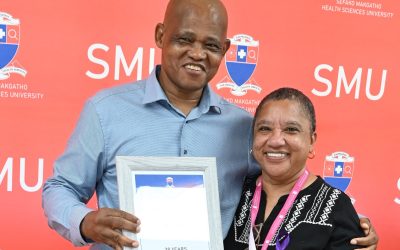
The National Research Foundation (NRF) rating system plays a crucial role in building a globally competitive science system in South Africa. It serves as a valuable benchmark, assessing researchers’ quality and impact through international peer reviews. This system encourages researchers at Sefako Makgatho Health Sciences University (SMU) to publish high-quality outputs in esteemed journals, fostering academic excellence.
 Dr Hammed Abass, a distinguished researcher in Mathematics and Applied Mathematics at SMU, has been awarded the prestigious Y2 rating by the NRF, marking a significant milestone in his academic career. This recognition underscores his potential to establish himself as a leading researcher, as acknowledged by national and international reviewers.
Reflecting on this achievement, Abass expressed gratitude for the honour and the opportunities it presents for future research. “This rating reflects years of dedication and perseverance to research excellence. It validates the effort I have put into advancing my knowledge and contributing to the field of mathematics,” he says. “Knowing that my work is recognised at a national level encourages me to pursue new ideas and projects.”
The Y2 rating, awarded to young researchers under 40 who have held a doctorate for less than five years, serves as an indicator of research excellence and potential. Abass noted that this recognition would enhance his credibility and provide opportunities for funding, collaboration, and participation in prestigious academic events.
Abass’ journey in Mathematics and Applied Mathematics has been shaped by an enduring passion for solving real-world problems. Significant milestones, including numerous high-impact journal publications, conference presentations, and leadership roles in academic and research communities have marked his academic trajectory.
Among his notable achievements is his recognition as one of the top authors by scholarly output in Africa. “Publishing in reputable journals has strengthened my visibility and allowed me to contribute to the growing body of knowledge in my field,” he remarks.
His participation in international conferences has facilitated invaluable networking opportunities, leading to fruitful collaborations and innovative research directions. “Engaging with researchers globally has expanded my perspectives and introduced me to new methodologies,” he adds.
Abass’ research focuses on fixed point theory, optimisation problems, and operations research. His work extends beyond theoretical contributions, influencing fields such as medical imaging, supply chain management, and logistics planning.
“My goal is to bridge theoretical advancements with practical applications,” he explains. “For instance, fixed point theory has crucial applications in pharmacokinetics, neural dynamics, and psychological modelling.”
He emphasised the importance of interdisciplinary collaboration in enhancing the impact of mathematical research. “Working with health scientists, engineers, and data analysts has allowed me to apply mathematical models to real-world challenges,” he notes. His research has contributed to areas such as medical image reconstruction and signal processing.
Receiving the Y2 rating is expected to significantly impact Abass’ career trajectory, providing him with enhanced visibility and opportunities for collaboration. “This recognition positions me for leadership roles in research projects and academic committees,” he says.
With plans to collaborate on interdisciplinary projects, publish high-quality research, and mentor aspiring mathematicians, Abass is committed to furthering mathematical research in South Africa and beyond. “I aim to create workshops and seminars that inspire young researchers and contribute to the mathematical community.”
Despite his success, Abass acknowledged the challenges he has faced, including securing research funding and balancing teaching, research, and administrative responsibilities. However, his persistence and strategic approach have helped him navigate these obstacles. “The ability to persevere and learn from setbacks has been crucial in my journey,” he shared.
Looking ahead, Abass envisions a bright future for Mathematics and Applied Mathematics in South Africa, particularly in health sciences. “By embracing interdisciplinary collaboration and leveraging advancements in data science, we can address complex public health challenges and improve outcomes,” he asserts.
He encourages young researchers to remain enthusiastic, build strong academic foundations, and actively seek mentorship. “Engaging with the academic community, publishing regularly, and embracing collaboration are essential steps to achieving success in research,” he advises.
He also highlights the role of institutions like SMU in supporting researchers. “Providing funding, fostering interdisciplinary collaborations, and establishing mentorship programmes can help researchers achieve international recognition,” he says.
Abass extended his gratitude to those who have played a pivotal role in his journey, including his PhD supervisor, Professor Tosin Mewomo, and colleagues from the University of KwaZulu-Natal and SMU. “Their guidance and support have been instrumental in my growth as a researcher,” he acknowledges.
Finally, he expressed appreciation to his family and host, Prof Maggie Aphane, Head of the Department of Mathematics and Applied Mathematics at SMU, for their unwavering encouragement. “This achievement would not have been possible without their support. Together, the sky is just the beginning,” he concludes.
With his Y2 NRF rating as a stepping stone, Abass is poised to make even greater strides in mathematical research, inspiring the next generation of scholars and contributing to impactful advancements in academia and industry.
By Tumelo Moila