Sefako Makgatho Health Sciences University (SMU) reaffirmed its commitment to research excellence and innovation when its Department of Mathematics and Applied Mathematics hosted the “Optimal Control and Optimisation: Theory, Algorithms and Applications” research workshop recently at the Batter Boys Boutique Hotel in Pretoria. Supported by the DSTI-NRF Centre of Excellence in Mathematical and Statistical Sciences (CoE-MaSS), the workshop brought together postgraduate students, postdoctoral researchers, academics, and industry stakeholders to explore cutting-edge developments in mathematical sciences and their applications to real-world challenges.
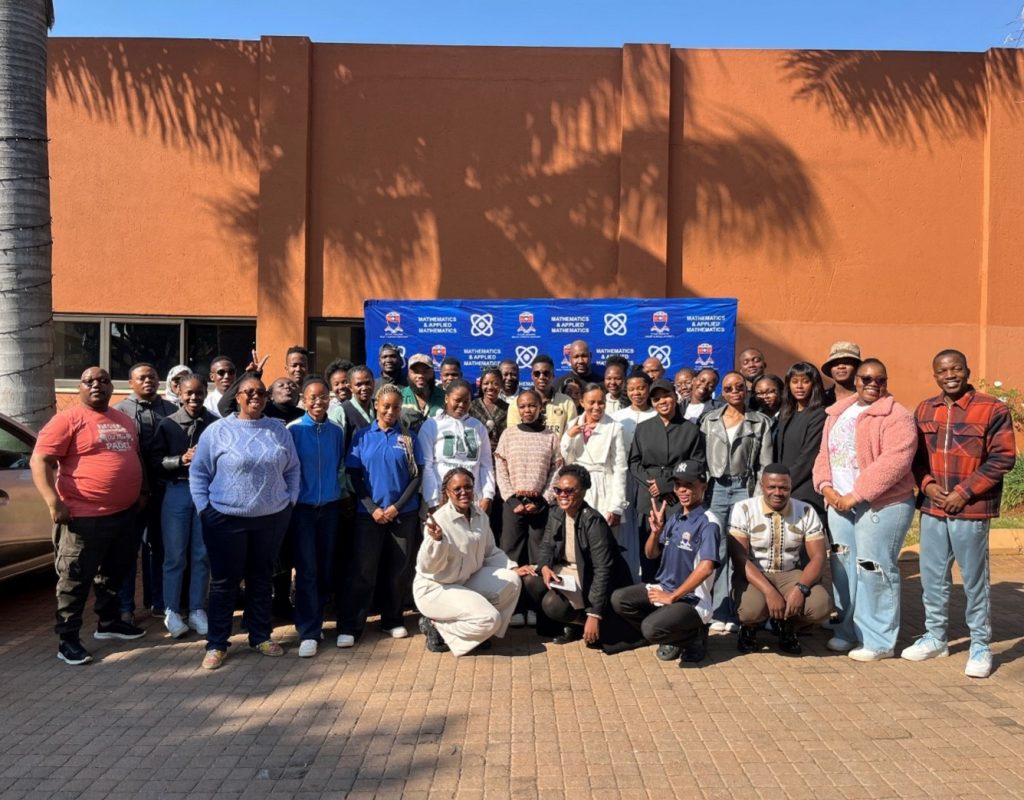 Opening the event, Professor Maggie Aphane, Head of the Department of Mathematics and Applied Mathematics, welcomed delegates and emphasised the importance of research collaboration, innovation, and academic excellence in advancing mathematical knowledge and its societal impact.
The first day focused on postgraduate research, providing emerging scholars with a platform to present their work and engage with experts in the field. The keynote address was delivered by Dr Simo Mthethwa, who presented a lecture titled The Lattice of Ideals and its Applications to Topology. His presentation introduced participants to key concepts in lattice theory and demonstrated their relevance to topology and broader mathematical thinking.
Highlighting the importance of linking theory to practice, Dr Mthethwa remarked: “If you define a mathematical concept and you cannot give an example, it does not exist.” His message resonated strongly with participants, reinforcing the value of applying abstract mathematical concepts to practical problems.
Research presentations covered a diverse range of topics, including optimisation theory, fixed-point theory, numerical analysis, mathematical finance, and machine learning. Presenters included Koketso Malebana, Malose Jim Mokonyama, Lerato Zelda Riba, Mbali Precious Phama, and Tumelo Fortunate Maloka, whose work reflected the breadth and growing impact of mathematical research within the department. Robust discussions following each presentation created opportunities for critical engagement, scholarly feedback, and professional development.
The second day shifted focus towards advanced research seminars and interdisciplinary dialogue. Doctoral candidates and postdoctoral researchers presented studies demonstrating the expanding role of mathematics across scientific and technological disciplines. Presentations explored applications in material science, metric space theory, optimisation algorithms, image restoration, variational inequalities, and computational mathematics.
Among the featured speakers were Tumisho Kekana, who examined topological indices of β12 borophene using mathematical modelling techniques, Anele Bokodisa, who presented new developments in bipolar quasi-metric spaces, Dr Austine Efut Ofem from the Tshwane University of Technology, and Dr Olawale Kazeem Oyewole, an NRF Postdoctoral Fellow at SMU, whose presentation highlighted contemporary advances in variational inequality theory.
A major highlight of the workshop was an interactive research dialogue involving Professor Aphane, Dr Mthethwa, academic staff, and postgraduate students. Discussions addressed research funding opportunities, publication strategies, academic career pathways, and the importance of collaborative research.
Dr Mthethwa encouraged students to build strong research networks and pursue interdisciplinary partnerships. He explained that collaboration strengthens research quality, expands access to funding opportunities, and creates pathways for international engagement and professional growth.
The workshop also provided valuable guidance on teaching and learning mathematics, emphasising conceptual understanding, problem-solving, analytical thinking, and proficiency in modern computational tools. Participants were encouraged to develop advanced software skills to enhance both their research capabilities and future employability.
Most presentations aligned with the workshop theme of optimal control and optimisation, showcasing how mathematical methods continue to drive innovation in fields such as finance, machine learning, computational modelling, and operations research.
The successful workshop highlighted SMU’s growing contribution to mathematical sciences research and its commitment to developing the next generation of scholars. By creating opportunities for knowledge exchange, collaboration, and professional development, SMU continues to strengthen its position as a leading institution advancing research excellence, innovation, and societal impact in South Africa and beyond.
By Tumelo Moila