
Sefako Makgatho Health Sciences University (SMU) PhD candidate Christopher Thapelo Mamaregane has earned recognition for research investigating the potential impact of coal mining on water quality in Limpopo’s Waterberg region, highlighting the university’s contribution to environmental chemistry and public health.
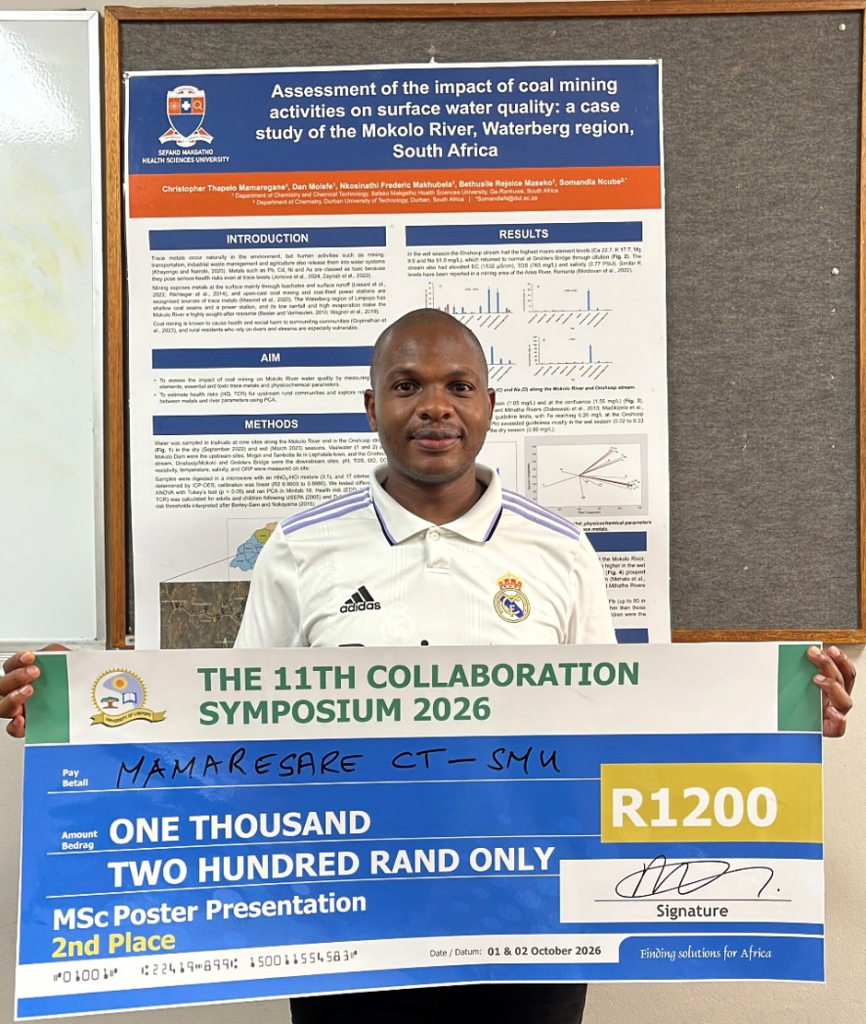 Mamaregane, a doctoral candidate, won 2nd place in the MSc Poster Presentation Award at the 11th Collaboration Symposium, organised by the Head of the Department of Chemistry and Chemical Technology at SMU and hosted by the University of Limpopo. The award recognised his research titled “Assessment of the Impact of Coal Mining Activities on Surface Water Quality: A Case Study of the Mokolo River, Waterberg Region, South Africa. For his efforts, he took home a cheque of R1 200.
The research examines whether coal mining activities contribute trace metals to the Mokolo River and assesses the potential health risks for communities using its water. The study involved sampling during the dry and wet seasons, analysing 17 elements and physicochemical properties, and conducting a human health risk assessment. “Honestly, it came as a shock because the presenters from other institutions were very good,” said Mamaregane. “This work took a lot of fieldwork, laboratory analysis and data interpretation, so seeing it recognised by the symposium was very humbling.”
Motivated by his upbringing in Limpopo, Mamaregane wanted to address a local environmental concern through scientific evidence. He explained that the Waterberg’s limited rainfall and high evaporation make the Mokolo River an important resource for domestic and industrial use, increasing the need to understand potential pollution sources.
The findings showed elevated metal concentrations in the Onshoop stream, which originates from the coalfields, but these declined sharply after the stream joined the Mokolo River. The results suggest that dilution reduces metal concentrations entering the river. At the same time, statistical analysis indicates that natural geological processes and surface runoff may be significant sources of metals in the catchment.
However, the health risk assessment identified concerns for rural communities upstream, particularly children, who were found to be more vulnerable to exposure to certain metals, including arsenic, cobalt, cadmium, chromium and lead. The findings indicate that people should not drink the river water without appropriate treatment.
Mamaregane cautioned against drawing definitive conclusions about mining’s overall impact, noting that the research team could not access the mine’s holding dams or effluent discharge points. Financial constraints also presented challenges, as the study relied on the university’s limited resources without external funding.
Dr Molefe, the former supervisor, said the research demonstrated the quality and potential impact of postgraduate scholarship at SMU. He highlighted its originality, technical excellence, reproducibility and significance to the field of chemistry, adding that recognition at the symposium could strengthen collaboration and raise the university’s research profile nationally and internationally.
The study has also been published in Environmental Research, in a special issue focusing on mining, water and climate. Mamaregane said the next phase would involve continued river monitoring, particularly during the dry season, and collaboration with mining stakeholders to investigate pollution sources, including a lead concentration spike identified at Mogol.
He encouraged fellow postgraduate students to participate in research competitions, stressing the importance of presenting credible findings and acknowledging research limitations. “Clean water is everyone’s concern, and the answer is not always simple,” he said. “Continued monitoring and cooperation between researchers, industry and communities are how we protect it.”
Mamaregane’s achievement reflects SMU’s commitment to excellence in teaching, learning, and innovative research, showing how postgraduate research can generate evidence to inform environmental management, protect public health, and support sustainable water use.
According to the HOD, Prof. Motaung, the symposium is designed to nurture talent, empower, and showcase the capabilities of a generation that was previously disadvantaged. For the first time, the event attracted international delegates, marking a significant milestone in its growth and global recognition. Mamaregane’s win of the poster presentation award reflects the quality of research at SMU and highlights the institution’s commitment to excellence, innovation, and developing emerging researchers.
By Tumelo Moila