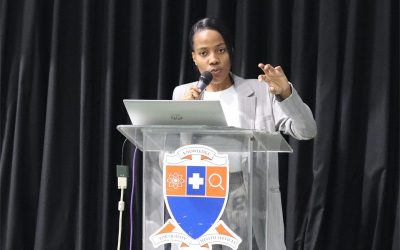
A brilliant young scholar from Sefako Makgatho Health Sciences University (SMU), Tumiso Matsobane Kekana, is redefining the intersection of Mathematics and Material Science through his pioneering research in Chemical Graph Theory (CGT). His work, which investigates the structural and mechanical properties of complex molecular compounds such as dendrimers and graphene, has attracted both national and international recognition for its scientific precision and potential applications in nanotechnology and materials engineering.
 Born on 22 July 1997, Kekana recently graduated cum laude with a Master of Science in Mathematics from SMU. His dissertation, “Computational Analysis of Complex Dendrimer and Graphene Structures via Neighbourhood Multiple Degree-based Topological Indices and M-Polynomials,” advances the mathematical modelling of molecular structures and their behaviours under various conditions.
“Mathematics is not just about numbers—it’s about revealing the patterns that govern our universe,” he explains. “Through Chemical Graph Theory, we can predict the properties of materials before they even exist in a lab. That’s the power of mathematical innovation.”
At the core of Kekana’s study lies the use of Topological Indices (TIs)—numerical descriptors that model molecular structures as graphs. His research introduces neighbourhood multiple degree-based TIs, offering more accurate predictions of graphene’s mechanical properties, such as Young’s Modulus, Poisson’s Ratio, and Shear Modulus. His results confirm the predictive strength of these mathematical tools, marking a step forward in computational chemistry.
Beyond research, Kekana is a full-time lecturer in SMU’s Department of Mathematics and Applied Mathematics, where he teaches Advanced Calculus and Linear Algebra and mentors young mathematicians. Through his involvement in the department’s Community Engagement Committee, he helps organise mathematics competitions and outreach programmes for high school learners, nurturing future problem-solvers.
“Relevance beats cleverness every time,” he reflects. “If our teaching and research don’t connect to real-world challenges, then we’ve missed the purpose of science.”
 Kekana’s contributions have been recognised through peer-reviewed publications in international journals such as Frontiers in Applied Mathematics and Statistics and Discrete Mathematics, Algorithms and Applications. His recent paper, co-authored with Dr Kazeem Aremu and Professor Maggie Aphane, presents a new method for computing topological descriptors of graphene using Neighbourhood Multiple M-Polynomials—a breakthrough simplifying complex molecular analysis.
Kekana’s success story began on the dusty streets of Ivory Park. After matriculating from Thuto Ke Maatla Comprehensive School in 2015 with results that initially barred university admission, he spent two years upgrading his marks at Tembisa High ABET School. In 2018, he was finally accepted to study Mathematics at SMU—a dream fuelled by his mentor, Godfrey Tshehla (PhD candidate in Financial Mathematics at Wits), whose passion for mathematics inspired him deeply.
Although he failed his Honours year in 2021, his supervisor, Dr Aremu, refused to let him quit. “He reminded me of my ‘why’,” Kekana recalls. Repeating the programme in 2022, he graduated with distinction.
Yet another obstacle emerged after his Honours degree: university debt barred him from accommodation and registration. Forced back to his two-room shack in Ivory Park, he began his Master’s degree under severe hardship—no electricity, no proper study space, and constant financial strain. To survive, he sold achaar and relied on Hands of Compassion, the SMU feeding scheme. Drawn by the difficult environment, he briefly turned to gambling (dice), even becoming a “knox man” as a means of survival. Despite these challenges, he completed his MSc degree cum laude in record time and published two Q2-ranked journal papers.
Now a PhD student, full-time researcher, and lecturer, Kekana’s journey embodies resilience, passion, and purpose. “Where you start doesn’t define where you can go,” he says. “With perseverance, even dust can give birth to diamonds.”
By Tumelo Moila