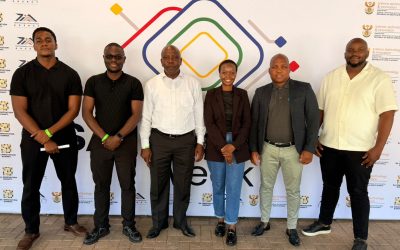
Sefako Makgatho Health Sciences University (SMU) is celebrating a major milestone after two of its BSc Honours (Computer Science and Information Technology) students secured first place at the prestigious RMB x GirlCode Group Hackathon, reinforcing the institution’s growing reputation for excellence in computing and innovation.
 Tsholofelo Sekome and Jennifer Mkhonto were part of a five-member team that emerged victorious during the competition held recently. The hackathon is widely recognised as a leading platform aimed at empowering women in technology and promoting diversity within South Africa’s fintech sector. Competing against some of the country’s brightest emerging developers, the team demonstrated exceptional technical skill, teamwork, and resilience under pressure.
Joining Sekome and Mkhonto were Paidamoyo Mapfuwa (University of Johannesburg), Neliswa Ntintili (University of the Witwatersrand), and Caitlyn Pillay (IIE). Together, they impressed judges by building a high-performance trading platform, “Tradebook Pro”, from scratch in just 48 hours. The system replicated the core functions of real-world financial exchanges, highlighting both technical depth and practical application.
The challenge required participants to design a fully functional, industry-grade trading platform capable of processing and matching buy and sell orders in real time. Guided by coaches Zwivhuya Tshitovha and Ashay Makanjee, the team prioritised building a robust and scalable system that could meet the demands of modern financial markets.
Sekome, who led the backend development, focused on architecting the core engine responsible for order matching and system performance. “I focused on developing the backend architecture using Java, ensuring that the system could handle complex financial requirements while maintaining low latency and high performance,” she said. “Building a robust trading platform from the ground up was one of the most rewarding challenges I’ve taken on.”
Mkhonto played a pivotal role in ensuring seamless system integration, contributing to both backend development and data management. Working closely with Sekome, she helped design the matching engine that enforced fairness and efficiency in trade execution.
“In just two days, we designed and built a full trading solution, thinking through everything from frontend to backend to persistence, while keeping performance at our core,” Mkhonto said. “This win reflects the strength of collaboration and shared vision.”
The platform’s backend handled order processing, trade execution, and matching logic with precision. By using advanced data structures such as TreeMap for automatic price sorting and ArrayQueue to enforce price-time priority, the team ensured fairness in transactions. The integration of SQLite further enabled reliable data storage, ensuring that all trades were securely recorded.
Judges commended the team for delivering a solution that met industry-level standards for scalability, speed, and accuracy—key requirements in financial technology environments. “It was an intense exercise in designing a system capable of handling complex financial requirements, all while racing against the clock to bring the core logic to life,” Sekome said. “Every edge case mattered.”
For Mkhonto, the experience was both professionally and personally transformative. “This hackathon taught me that I belong in tech,” she said. “Seeing our system execute its first trade after hours of debugging was an unforgettable moment.”
The RMB x GirlCode Hackathon continues to play a vital role in creating opportunities for women in technology by providing mentorship, exposure, and a competitive platform to showcase talent. The team acknowledged the guidance of their coaches and the broader support system that contributed to their success.
“We are incredibly grateful to our coaches for guiding us and pushing us to the finish line,” Sekome said. “We also thank RMB and GirlCode for creating a platform that empowers women in tech.”
For SMU, this achievement underscores the strength of its Computer Science and Information Technology programme today.
By Tumelo Moila