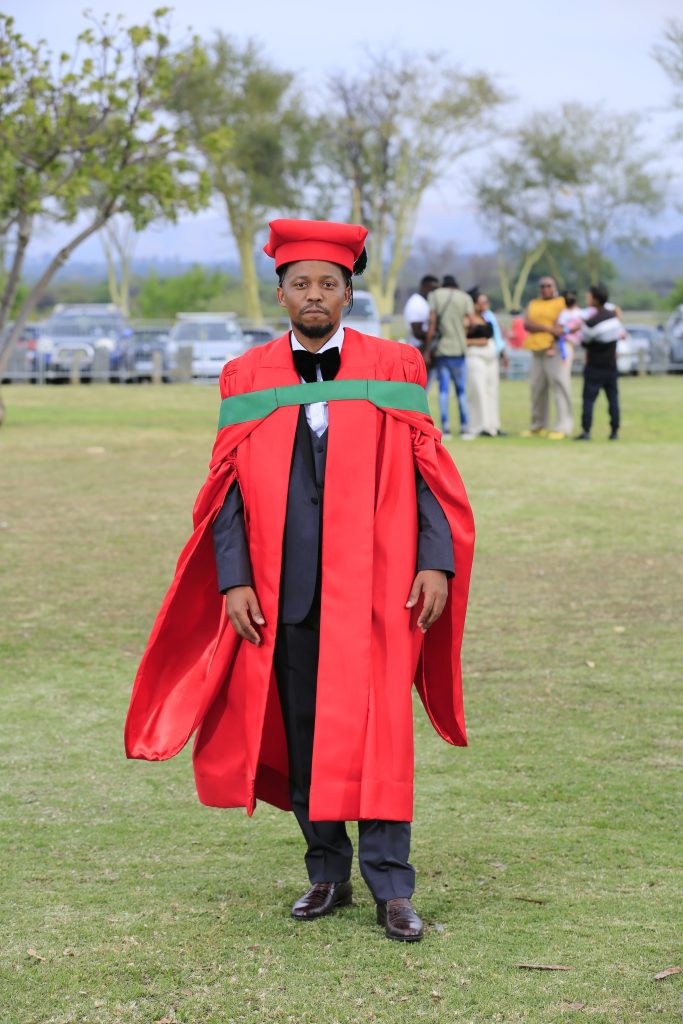
Sefako Makgatho Health Sciences University (SMU) is advancing scientific innovation through the work of Dr Walter Bonke Mahlangu, who recently graduated with a Doctor of Philosophy (PhD) in Chemistry at the university’s Annual Spring Graduation Ceremony. His research explores using artificial intelligence (AI) to improve the synthesis and application of organometallic compounds, with potential benefits for chemical research, industrial processes, and materials development.
 Titled Developing an artificial intelligence predictive model for synthesis and application of organometallic compounds, the study addresses a longstanding challenge in chemistry: the time, resources and chemical waste associated with traditional trial-and-error approaches to developing and optimising chemical reactions.
Organometallic compounds, which contain covalent bonds between metal and carbon atoms, play an important role in organic synthesis, materials science and industrial chemistry. Mahlangu investigated how machine learning and deep learning could improve their identification, classification and design by predicting chemical structures and reaction characteristics from molecular data.
“Artificial intelligence offers an opportunity to rethink how chemists approach complex synthesis problems. By using predictive models to analyse molecular structures and identify patterns, we can work towards more efficient research processes and reduce reliance on trial-and-error experimentation,” explains Dr Mahlangu.
The research was conducted in three phases, combining molecular fingerprints with machine learning algorithms, including Random Forest, K-Nearest Neighbours, Support Vector Classification and Multi-layer Perceptron neural networks. The first phase developed a model to identify metal–carbon bonds, achieving an F1-score of 0.85 and an area under the receiver operating characteristic curve (AUC-ROC) of 0.837, demonstrating its ability to distinguish relevant molecular structures.
In the second phase, Mahlangu applied clustering techniques to classify organometallic reactions into six to eight major categories. Different algorithms performed well in identifying broad reaction groups, while hierarchical clustering proved more effective at distinguishing subtle differences between related reactions. These findings could support more systematic organisation and analysis of complex chemical reactions.
 The final phase focused on predicting reaction yields and catalyst structures. While the models performed strongly when predicting certain intrinsic molecular properties, forecasting reaction yields remained challenging because these depend on multiple experimental factors. However, a deep learning model achieved a peak accuracy of 85.7% in predicting catalyst and reagent structural features, demonstrating potential for automated screening and chemical design.
Mahlangu’s research reflects the value of combining established scientific disciplines with emerging technologies. “The findings highlight the importance of selecting appropriate molecular descriptors and machine learning architectures for specific chemical problems. Although challenges remain, particularly in predicting reaction yields, the results provide a foundation for further research into AI-assisted catalyst design,” he shares.
His doctoral achievement builds on previous research, including published work on analysing bisphenols in canned foods and machine learning-based classification of organometallic reactions. He also helps develop future scientists through his work as a principal lecturer at Eduvos and by supervising and co-supervising undergraduate and postgraduate research at SMU.
Dr Mahlangu’s graduation highlights the growing importance of interdisciplinary research in addressing complex scientific challenges. By integrating computational methods and chemistry, his work helps explore more efficient, data-driven approaches to chemical synthesis and catalyst discovery.
SMU continues to advance academic excellence through postgraduate education, innovative research and scientific capacity development. Mahlangu’s achievement reflects the university’s commitment to excellence and innovation, supporting researchers whose work expands scientific knowledge and explores solutions to emerging challenges.
By Tumelo Moila