by Lorato | Oct 9, 2024 | All News, SMU Media, Student Media
At the forefront of transformative dialogue, Sefako Makgatho Health Sciences University (SMU) hosted an engaging panel discussion as part of the Advanced Future Scientists and Healthcare Leaders’ Summit. Leaders from academia, industry, and government gathered to tackle the pressing challenge of bridging the gap between academic research and real-world application. This conversation is key to unlocking innovation, creating impactful collaborations, and driving progress in sectors such as technology, education, and public health. The esteemed panelists brought diverse perspectives and insights to the table, addressing how partnerships between universities, private companies, and government institutions can help bridge this gap and propel research beyond the academic world into tangible solutions that benefit society.

Prof Tandi Matsha-Erasmus – DVC Academic and Research
Meet the panelists:
Prof Tandi Matha-Erasmus – Deputy Vice-Chancellor, Academic, Research, and Innovation, SMU: Emphasised the need for academic institutions to foster research that advances knowledge and meets the needs of industry and society. She highlighted SMU’s commitment to bridging this gap through strategic partnerships and interdisciplinary innovation.
Grant Ruskovich – Chief Partnership Officer, UCT Online High School: Discussed how the education sector is transforming, particularly with the rise of digital learning platforms. He noted that collaborations between universities and high-tech education providers can help address challenges in education, providing scalable solutions for learners and educators alike.
Siya Ntlahla – Talent and Leadership Development Specialist: Spoke about the importance of talent development and leadership in driving innovation. He emphasised the role of mentorship and structured programmes in preparing young professionals and graduates to thrive in both academic and corporate settings.
Dr Rendani Mamphiswana – Head of Research and Innovation, Nafasi Water: Explored how cutting-edge research in water innovation can address critical environmental challenges. He underscored the importance of collaboration between research institutions and industries to create sustainable solutions.

Prof David Katerere – Director of CSIR Cannabis Research Hub
Prof David Katerere – Director, CSIR Cannabis Research Hub: Highlighted the potential of the cannabis industry for health and economic development. He focused on how academic research, government regulation, and industry investment can lead to breakthroughs in pharmaceuticals, health products, and sustainable agriculture.
Kevin Distiller – Managing Director, Odyssey Talent Management: Shed light on the growing demand for industry-ready talent. He discussed the role of talent managers in ensuring that graduates from academic institutions are equipped with the necessary skills to meet industry demands and how academia can better align its programmes with evolving job markets.
Dr Lusani Netshitomboni – Director of Communication & Marketing: Led the discussion, encouraging collaboration between academia, government, and private enterprises to maximise innovation impact. He emphasised the importance of communication and partnerships in making research visible and valuable beyond university walls.

Ntshadi Bokaba – Deputy President of SMU SRC
Ntshadi Bokaba – SMU SRC Deputy President: Representing students, she discussed how young people are eager to see academic institutions play a more active role in innovation. She called for greater support for students and young researchers in accessing funding, mentorship, and partnerships that can help translate their academic work into market-ready solutions.
Molatelo Tsolodibane – Head of Sales Support, Liberty Standard Bank Group: Addressed the critical role financial institutions play in scaling innovations and supporting startups emerging from universities. She shared insights into the financial tools available for academic entrepreneurs to bring their ideas to market.
Dr Livhuwani Masevhe – Technology and Product Development Specialist: Discussed the intersection of technology and product development, emphasising the need for practical application of research to meet industry needs. He shared examples of how research innovations are being turned into marketable products benefiting industry and academia.

Panelists
The panel emphasised the critical need to bridge the gap between academia and industry, ensuring that research moves beyond the confines of the laboratory and into the marketplace. Students attending the discussions found the insights particularly beneficial, noting that the emphasis on practical applications of research inspired them to consider how their academic pursuits could translate into real-world solutions. Many expressed enthusiasm for the potential career opportunities that arise from stronger collaborations between universities and industry, fostering an environment where innovation can flourish and address pressing societal challenges.
The summit, unfolding until 11 October 2024, reaffirms SMU’s commitment to driving scientific innovation and nurturing future healthcare leaders, ensuring that the advancements made within its walls translate into lasting societal benefits.
#SMU #SMUShapingHealthSA #WeAreSMU

by Lorato | Oct 5, 2024 | All News
At Sefako Makgatho Health Sciences University (SMU), the commitment to student success extends far beyond the lecture halls. The upcoming Advancing Future Scientists and Healthcare Leaders: Work Readiness and Innovation Programme is a testament to the institution’s dedication to addressing the unique challenges faced by students in the science and healthcare fields.
This transformative programme is designed to empower a diverse group of future leaders with the essential skills, knowledge, and support needed for a seamless transition from academia to the workforce. Participants will engage in hands-on workshops, mentorship opportunities, and innovative projects that foster creativity and practical problem-solving.
The programme will feature a top-tier range of speakers, including Buti Manamela, Deputy Minister of Higher Education, as the keynote speaker at the Jobs4 Billions Summit, which kicks off on 09th October 2024. His insights into education, innovation, and youth employment will inspire and set the tone for the future-focused discussions throughout the event.
SMU students are encouraged to participate in the programme which aims to equip the next generation of healthcare professionals and scientists with the skills and knowledge they need to not just meet, but exceed the demands of an ever-evolving industry, setting them up for successful and fulfilling careers.
SMU is deeply committed to nurturing not just academic excellence but also the holistic growth of its students. Through initiatives like the Advancing Future Scientists and Healthcare Leaders Programme, the university reaffirms its unwavering commitment to equipping its students with the tools they need to thrive in their careers. SMU is dedicated to creating an environment where students can grow into innovative, compassionate healthcare leaders ready to tackle societal challenges. With programmes that bridge the gap between academia and the workforce, the institution continues to invest in the success and future of every SMU student.

by Lorato | Sep 9, 2024 | Accolades and Achievements, All News, SMU Media, Student Media
Sefako Makgatho Health Sciences University (SMU) has made significant strides in the Webometrics rankings for 2024. In the mid-year update, SMU broke into the top 3,000 globally, moving up from its previous rank of 3,058 to 2,869. This progress reflects SMU’s commitment to enhancing its digital presence and academic performance. On the local rankings, SMU moved up 2 places, to assume position 18 nationwide.
SMU’s improved ranking demonstrates the university’s growing influence and visibility in the global academic landscape. By actively participating in the ranking systems and increasing its online engagement, SMU has showcased its research output and institutional achievements to a broader audience. “This upward trajectory in the Webometrics rankings highlights SMU’s dedication to academic excellence and its ongoing efforts to strengthen its position in the digital arena. It not only elevates SMU’s recognition within the international academic community but also positions it as a competitive institution in the rapidly evolving digital landscape”, stated SMU Institutional Researcher, Mr Benjamin Ntshabele.
About Webometrics
Webometrics is a global ranking system developed by the Consejo Superior de Investigaciones Cientificas (CSIC), the largest public research organisation in Spain. Initially aimed at promoting web publication and supporting Open Access initiatives, Webometrics has evolved into a comprehensive tool for evaluating the digital presence and impact of universities worldwide. Webometrics emphasises a university’s overall online presence, offering a holistic view of institutional influence in the digital space. Webometrics ranks over 30,000 tertiary institutions worldwide, including universities, private institutes, and colleges, providing a broad analysis of global academic performance. The ranking system updates its results twice a year, offering universities an opportunity to track their progress and make improvements as needed. The primary objective of Webometrics is to measure the visibility, transparency, and excellence of higher education institutions (HEIs) by analysing the quality, quantity, and accessibility of their web content. Through this approach, Webometrics not only encourages universities to increase their digital engagement but also provides a broad perspective on their global standing in the academic community.
Webometrics Methodology
The Webometrics ranking system uses three core indicators to evaluate universities:
• Visibility (50% weighting): This indicator measures the number of external networks (subnets) linking to the institution’s web pages. The more external references a university has, the higher its visibility score, which reflects the global impact of its online presence.
• Transparency or Openness (10% weighting): This metric evaluates the number of citations from the top 310 authors at each university, excluding the top 30 outliers. This indicator is designed to assess the transparency of the institution’s academic contributions.
• Excellence (40% weighting): This component measures the number of papers published by the university that are among the top 10% most cited in their respective disciplines over the last five years. Excellence indicates the university’s research impact and academic quality.
The importance a good ranking
“Rankings increase the university’s visibility on the global stage and promotes initiatives geared towards internationalization, which is key to forging partnerships and networks amongst universities thus leading to cross-pollination in the academic space and the sharing of resources through students and staff exchange initiatives”, concludes Professor Bassy Marvey, Director of Institutional Planning and Quality Assurance at SMU.
Newsflash - SMU makes strides in global Webometrics Rankings
File size: 856.62 KB
Created: 09-09-2024
Updated: 09-09-2024
Hits: 161

by Lorato | Aug 20, 2024 | All News, SMU Media, Student Media
Prof. Thifhelimbilu Irene Munzhelele is the first black female Maxillofacial and Oral Surgeon (MFOS) in South Africa. Born at Ha-Magidi, a rural village in Venda, South Africa, she is the first generation in her family to attain university education. She is also the first and only black person to qualify as a MFOS with dual qualifications, (BChD and MBChB), both Dental and Medical degrees. Her academic qualifications include BChD (Medunsa), DipOdont in Oral Surgery (UP), MBChB (UP), MChD-Med MFOS (UP), FCMFOS (CMSA), Post graduate Teachers Diploma in Health Sciences Education (WITS) and a Certificate in Assessment (Rhodes University). In August 2024, she received a Women in Leadership certificate from the Nelson Mandela University (NMU).
Since qualifying, she has worked as a specialist MFOS for the South African Defence Force, and, she is currently the first black female HOD in her area of specialty, based at the Sefako Makgatho Health Sciences University (SMU).
MFOS as a specialty in dentistry started in South Africa in the 1950’s. It is a male dominated discipline across all racial groups with the very first woman MFOS only qualifying in 1998. A huge discrepancy indeed!
“I am very passionate about intentionally empowering other women. Since I took over as HOD, I have produced a couple of female MFOS, and, there are still more women in the programme”, she said.
Newsflash - Meet first black female Maxillofacial and Oral Surgeon (MFOS) in South Africa, Prof Thifhelimbilu Irene Munzhelele
File size: 0.97 MB
Created: 20-08-2024
Updated: 20-08-2024
Hits: 258
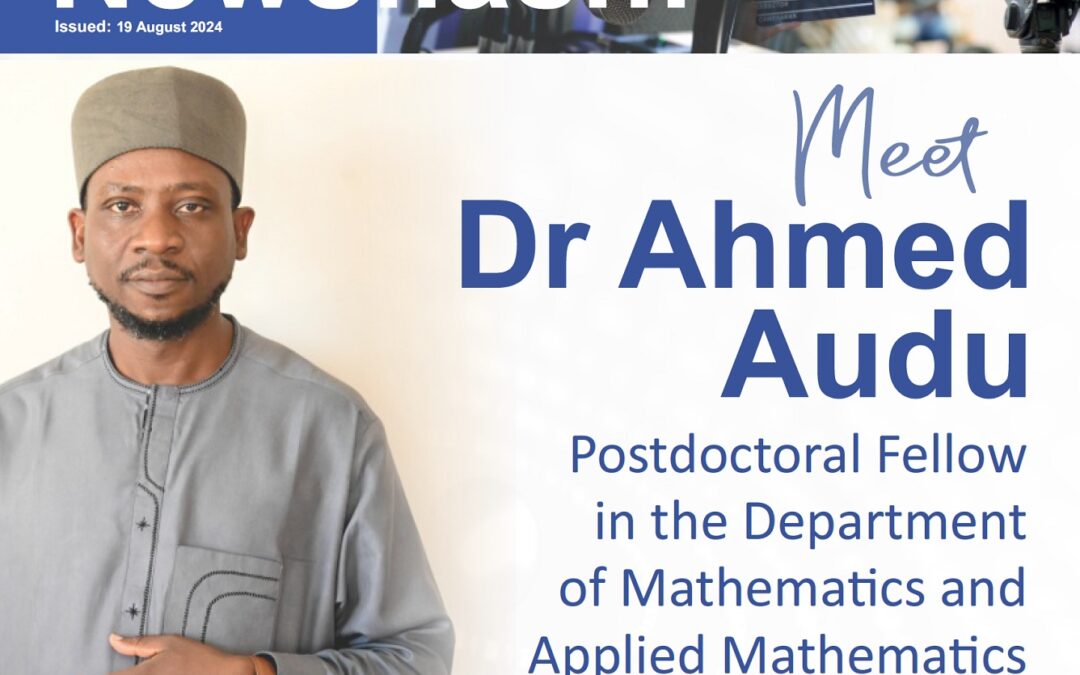
by Lorato | Aug 19, 2024 | All News, SMU Media
The impact of mathematics research on society is significant and far-reaching, resulting in many scientific and technological breakthroughs. Developments in physics, chemistry, computer science, and engineering heavily rely on mathematical principles and models. Without the continuous advancement of mathematical research, the modern technological world would be impossible. Recently, Postdoctoral Research Fellow (PRF), Dr Ahmed Audu joined Sefako Makgatho Health Sciences University (SMU) to develop his career as an academic researcher in mathematical statistics under the supervision of Professor Maggie Aphane, Head of Department: Mathematics and Applied Mathematics. His fellowship is funded by the Tertiary Education Trust Fund (TETFUND), a Nigerian government agency.
Dr Audu’s educational qualifications entail a Doctor of Philosophy in Statistics (University of Ilorin, Nigeria); Master of Science and Bachelor of Science in Statistics (Usmanu Danfodiyo University, Nigeria); Professional Diploma in Education (Ahmadu Bello University, Nigeria); and National Diploma in Statistics (Niger State Polytechnic Zungeru, Nigeria). He is a seasoned academic with extensive work experience as a Senior Lecturer, Lecturer, Assistant Lecturer, and Graduate Assistant at Usmanu Danfodiyo University.
His responsibilities include collaborating with other researchers. He is expected to publish, at least, five articles in the accredited Institute for Scientific Information (ISI) journal and work closely with principal investigators, professors, and other research staff members. This allows him to learn new techniques and approaches from more experienced researchers.
“Mathematical research leads to the development of tools and techniques that can be applied to solve complex real- world problems. These include areas such as weather prediction, cryptography, and virus modelling. The study of mathematics trains individuals to think logically, analyse problems systematically, and develop effective solutions. These skills are invaluable in many aspects of life, from personal finance to complex decision-making,” explains Dr Audu.
Understanding and applying mathematical concepts empowers individuals to engage meaningfully in discussions and initiatives that address global challenges, such as climate change, sustainable development, and data- driven decision-making. Dr Audu’s areas of research interest are mathematical and applied statistics. He specializes in mathematical statistics, sampling theories and survey methods to be specific.
A solid foundation in mathematical statistics is essential for pursuing postgraduate studies in fields like econometrics, biostatistics, machine learning, and operations research. The analytical and quantitative skills developed during the study of mathematical statistics provide a strong foundation for further academic and professional development. His current students at SMU have a mathematics background with little exposure to statistics. As a result, he organised a series of lectures and presentations with them to bridge the missing gaps and he was overwhelmed with the speed of their understanding.
“I am currently supervising some postgraduate students in the department of mathematics in collaboration with some staff members of mathematics and statistics. I am training them in mathematical statistics especially sampling theory and survey methods. This will complement and enhance the existing research programmes at the university. The results of the interactions will also lead to discoveries, publications, and advancements in the field” enlightens Dr Audu.
Dr Audu said Postdoctoral Research Fellow (PRF), experience will lead to mentorship and guidance, development of new skills and techniques, enhanced publication record, networking and collaborations and exposure to diverse research environments. This is what motivated him to join SMU. He said the ranking of SMU among its peers in Africa and globally motivated him. “I am not a mathematician, but a statistician. Nevertheless, statistics is a subset of mathematics. So, I love mathematics. I found it easier to understand its concepts. I see logical thinking and problem-solving skills required in mathematics as an enjoyable mental exercise. The goal of any academician is to attain the apex rank of the career and I’m not an exception. But my focus now is career development through experiences and collaborations,” he concluded.
Newsflash - Meet Dr Ahmed Audu Postdoctoral Fellow in the Department of Mathematics and Applied Mathematics
File size: 2.01 MB
Created: 15-08-2024
Updated: 19-08-2024
Hits: 163
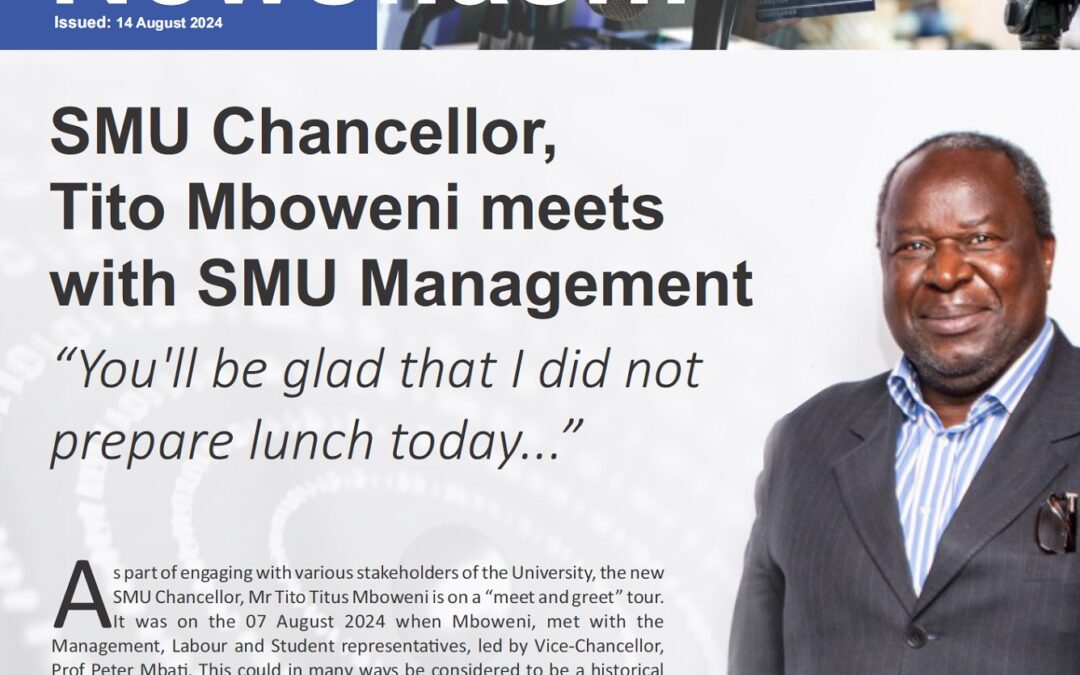
by Lorato | Aug 14, 2024 | All News, SMU Media
As part of engaging with various stakeholders of the University, the new SMU Chancellor, Mr Tito Titus Mboweni is on a “meet and greet” tour. It was on the 07 August 2024 when Mboweni, met with the Management, Labour and Student representatives, led by Vice-Chancellor, Prof Peter Mbati. This could in many ways be considered to be a historical moment. In the midst of the excitement in the room, as colleagues introduced themselves, in response to a colleague who appreciated the Chancellor’s culinary skills, he said “You’ll be glad that I did not prepare lunch today”, much to the laughter of the members in the room.
The meeting started with a brief reflection, led by Prof. Mbati, on the University’s achievements and future plans with regard to infrastructure, academic development, research and innovation, further reflecting on the organizational culture and the stability on campus. He further indicated the need to introduce new academic programmes and complementary staff to ensure the university’s financial sustainability.
But who is Mr Mboweni?
Mr Mboweni served as Minister of Finance and Minister of Labour. He was Deputy Head of the Department of Economic Policy in the African National Congress (ANC). He also represented the ANC on several domestic and international platforms. Furthermore, he was the eighth Governor of the South African Reserve Bank (SARB). Educationally, Mr Mboweni obtained a Bachelor of Arts (honours equivalent) degree in Economics and Political Science from the National University of Lesotho in 1985. In 1987 he obtained a Master of Arts degree in Development Economics from the University of East Anglia in England.
Currently, he is an International Advisor to Goldman Sachs International and chairman of the following companies: Accelerate Property Fund, Nampak Limited, and SacOil Holdings Limited. He is also a non-executive director at Discovery Limited and a founding partner of Mboweni Brothers Investment Holdings.
As a former Governor of the South African Reserve Bank, Mboweni’s signature is still circulating with some of the bank notes in use to this today – a testament that he is one of the well-known public figures in our country. The meeting underscored the following, amongst others:
- A need to explore the possibility of bringing to fruition the establishment of a fit for purpose hospital, that could catapult the University to greater heights, particularly, in respect of its commitment to expand its clinical training platforms and research. In this regard, it was underscored that the current Dr George Mukhari Academic Hospital is not adequate for the training of a large cohort of health care professionals at undergraduate and post- graduate level.
- The imperative to leverage networks that the Chancellor built over time for the benefit of SMU, including exploring possible international partnerships between SMU and other like-minded institutions, both on the African continent and other parts of the world.
- Unlocking resources from the private sector with a view to supporting the University’s research niche areas and other capital raising projects the University has identified for its built programme.
- Investment in the academic and research infrastructure of the University could not be over-emphasised, including the creation of research chairs in areas where SMU has demonstrated remarkable strength over the years.
As the meeting concluded, it become clear that there is a need for SMU to identify key catalytic projects to ensure a focused approach to academic, infrastructure development, partnerships and resource mobilization to ensure its sustainability. Given the ease and effortlessness with which Mboweni shared his professional experience both in the public and private sector, SMU could not have appointed an excellent Chancellor. His knowledge of the Higher Education sector, and the possible interfaces it might need to deliberately create, was a demonstration of his pragmatic approach to issues. His ability to hold simultaneously in his thought processes that (i) contradictions are an inherent mechanism in the advancement of social change and (ii) the resources that universities need are largely in the hands of private capital, was a masterstroke. It was emphasized that public and private sectors in South Africa must work together, for the greater good of our country.
Newsflash - SMU Chancellor, Tito Mboweni meets with SMU
File size: 2.59 MB
Created: 14-08-2024
Updated: 14-08-2024
Hits: 188