
Sefako Makgatho Health Sciences University (SMU) academic Dr Veena Abraham has earned a PhD in Pharmacy through a collaborative doctoral programme with the University of Stirling in Scotland, highlighting the need for institutional policies that address mental health and burnout among university academics.
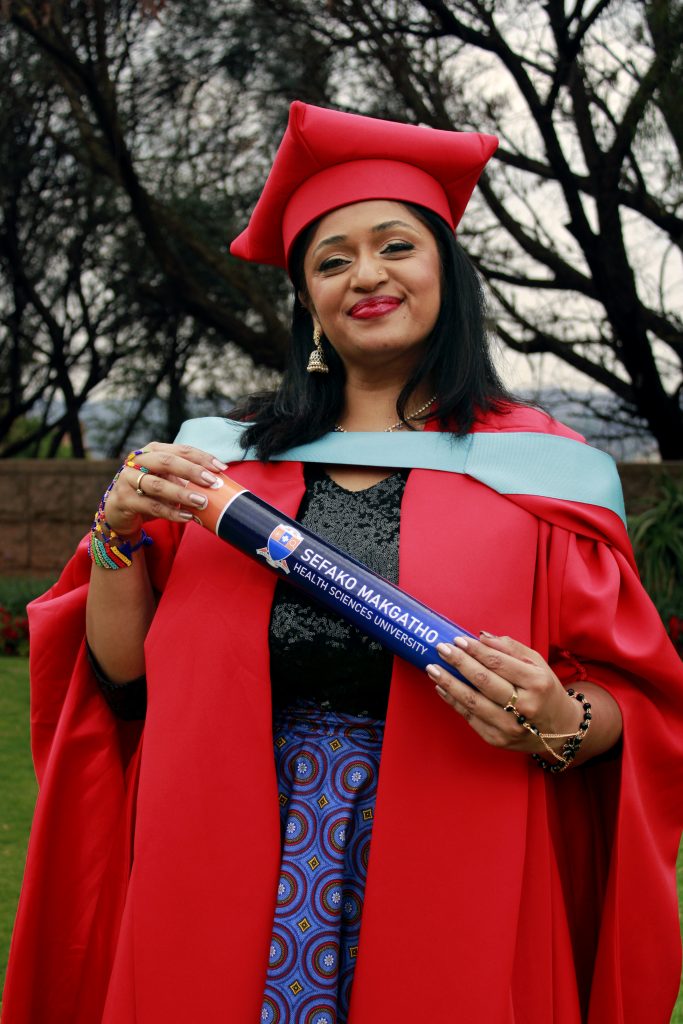 Awarded in 2026, her doctorate focused on developing and pre-testing an evidence-informed mental health promotion policy for academic staff at a historically disadvantaged South African university. Her research examined how workloads, organisational culture, leadership practices and limited institutional support affect staff wellbeing in higher education.
The study found that 49% of surveyed academic staff screened positive for severe psychological distress, while 27% reported high levels of burnout. The institutional survey involved 157 respondents and revealed that fewer than one-third felt comfortable disclosing mental health concerns, while more than half expressed dissatisfaction with institutional support.
“These findings highlight the importance of recognising mental health and burnout as workplace concerns that require institutional attention. Universities need to understand how working conditions, leadership practices and organisational culture affect academic staff and their ability to thrive professionally,” said Dr Abraham.
The findings highlight the scale of the challenge facing universities. As the study concludes, “Academic staff mental health is shaped by interconnected individual, organisational and structural factors.” This points to the need for institutions to look beyond individual wellness initiatives and address the workplace conditions contributing to psychological distress.
Dr Abraham’s research used a four-phase, mixed-methods approach, combining a systematic review of workplace mental health interventions, an institutional survey, qualitative interviews and a focus group, followed by policy development and stakeholder pre-testing. This enabled her to integrate international research evidence with the experiences and needs of academic staff in the South African higher education context.
“The research was driven by the need to develop a practical, evidence-informed response that reflects the realities of academic life in South Africa. Policies must be grounded in research and shaped by the experiences of the people they are intended to support,” she said.
The resulting policy framework addresses workload management, leadership accountability, psychological safety, access to mental health support and organisational culture. Stakeholder pre-testing indicated that the proposed policy was acceptable, although institutional readiness and implementation capacity remained important considerations.
 Emphasising the need for sustainable institutional action, the study concludes that “sustainable mental health promotion requires coordinated institutional action addressing the underlying conditions contributing to distress and burnout.”
The findings therefore support a shift towards approaches that recognise staff wellbeing as an organisational responsibility rather than an issue for individuals to manage alone.
Dr Abraham’s interest in workplace wellbeing developed from her earlier research into patient safety culture at Dr George Mukhari Academic Hospital, which she completed for her Master of Pharmacy degree, awarded cum laude in 2017 from SMU. This work informed her broader interest in how organisational environments, leadership and workplace practices influence professionals’ experiences.
With more than 15 years of experience in health sciences education, Dr Abraham lectures in SMU’s Department of Pharmacology and Therapeutics, teaching across health sciences programmes, including medicine and dentistry. Her academic contributions also include curriculum development, assessment, postgraduate supervision and mentorship.
She received the SMU Teaching Excellence Award in 2022 and has published research on workplace mental health, patient safety and healthcare practice. Her scholarly work reflects a commitment to connecting research evidence with practical institutional challenges.
“Creating healthier academic environments requires a sustained commitment to supportive leadership, open communication and policies that can be implemented in practice. I hope this research contributes to conversations about how universities can better protect and promote the wellbeing of their academic staff,” said Dr Abraham.
Dr Abraham’s achievement reinforces SMU’s commitment to research that responds to pressing challenges in education and the health sciences. By developing a contextually responsive mental health promotion policy, her research provides a foundation for universities seeking to strengthen workplace support, improve organisational practices and create healthier academic environments.
By Tumelo Moila