by Lorato | Jun 7, 2022 | All News, SMU Media
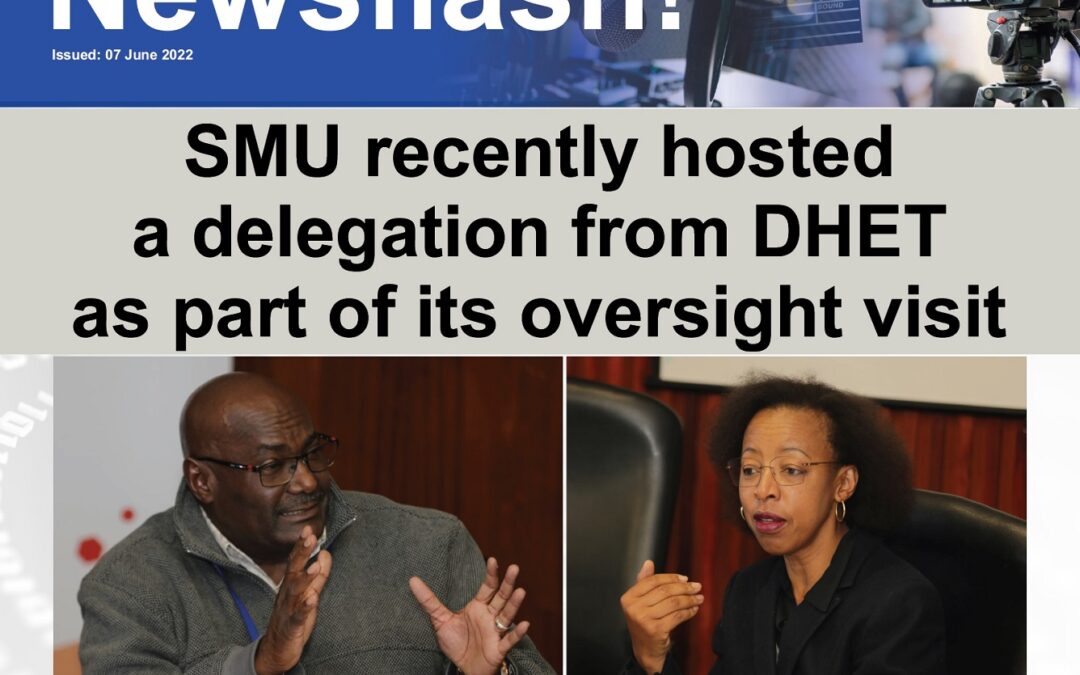
Vice-Chancellor Prof Peter Mbati recently hosted a delegation from the department of higher education and training who were on an oversight visit. Led by the Deputy Director General for University Education Dr Marcia Socikwa, the delegation came to engage with the university and see progress on projects funded by the department through the Sibusiso Bengu Development Programme.
In his welcoming address to the delegation in the presence of SMU management and officials, the Vice-Chancellor said the support SMU gets from the department in particular the Sibusiso Bengu grant has assisted a lot in a range of areas. He further told the delegation that SMU has completed a restructuring programme of Senior and Executive team to ensure alignment with the new strategic plan and to allow the University to deliver on its core mandate to increase efficiency in the system.
“We also very recently had a meeting of the senior management committee with a focus on the centrality of the academic project because many times one of the challenges we face in higher education and for various reasons is that we start to drift away from why we are created as higher education institutions and our focus and energy gets invested elsewhere”, said Prof Mbati.
He further mentioned that the University went through a culture survey and many processes to reconfirm from many stakeholders of the university from Council, labour, management, staff and students about the values SMU must embrace as a university to refocus and rededicate itself to what must be done.
“There is still a lot that has to be done at SMU and the funding we receive through the Sibusiso Bengu programme and the support from the department will help us deliver projects on time”, said the VC.
“We have a new business model to allow us to be financially sustainable over a period of time. We currently also get a special dispensation grant from the department to allow us to meet our obligations as a university. The new business model sets out projects that we need to embark on including increasing our student numbers, developing new programmes, expanding on the third stream income”, continued Prof Mbati.
The DDG Dr Socikwa in response said, “I must say that when one contrasts the universities this side with the urban centred ones, you are saddened, you immediately realize the need for extensive investment”. She also said the department wants to see excellence in our institutions and remember them for the legacies created. “We really need to reimagine how we want to be and I am happy that SMU has started with a new business model, we also need to acknowledge the vast sums of money directed at SMU. The university was allocated R144 million and managed to spent 120 million. Funding was made to support 11 projects at SMU and the department would like to look at and speak about them”, said the DDG.
She further mentioned that the delegation came to appreciate the challenges but also the opportunities and to engage vigorously as required so that by the time they left, they should be in a position to confident about the objectives of these investments and are able to support the University’s initiatives with the requisite enthusiasm and energy.
“We also need to understand what is required to turn around the fate of SMU. Since the inception of the development programme SMU received over 150 million and as a department we would like to see progress on the approved projects and are uncompromising on that. It is no secret that SMU is among the universities that have been able to deliver on their projects”, said Dr Socikwa. The department praised SMU for submitting its annual report way before time and called on other institutions to emulate SMU.
The Director for Development Grants at SMU Mr Theo Bhengu took the delegation through a presentation that detailed the projects that have been completed, those underway and proposed future projects. He reported that in the first cycle (2016/17-2020/21), the HDI-DG significantly contributed to achieving SMU strategic goals as a new institution after the demerger from the University of Limpopo (UL), through the following projects:
- Re-engineering of business processes
- Review of governance systems
- Document management system
- High Resolution Transmission Electron Microscope (HRTEM)
- Occupational Health and Safety (OHS) Audit
- Bulk Contribution to the City of Tshwane
- Establishment or increasing capacity of strategic departments, i.e. Institutional Planning, Development (Advancement & Internationalisation), Grants Management and Infrastructure Planning and Development
He further said that SMU has made proposals for funding under the Sibusiso Bengu programme on 18 new projects that are in line with the strategic objectives of the institution across all areas.
After robust discussions, Mr Alfred Makgatho from DHET gave a brief report on the proposed projects and also mentioned that there is support for the proposed projects pending approval from the Minister. However, he advised that there were several other projects that SMU will have to revisit as they could not be supported in their current form. The department placed emphasis on the future sustainability of the institution so that the University is able to fund its other programmes.
The CFO Mr Eminos Manyawi expressed the University’s appreciation to DHET for the continuous support and committed to furnish the department with all necessary documents and reports. He further pleaded for further funding to finance planned projects. During the tour of campus, the delegation was taken through the premium 2000 beds facility which is at an advanced stage towards completion, the bulk water project currently under way, the electron microscope unit and other projects.
The visitors were later taken on a campus tour to see amongst others, the premium 2000 beds student accommodation facility financed by the department, the facility for relocation of the Electron Microscope Unit that is being renovated. Once completed, the facility will ensure stability of the new High Resolution Transmission Electron Microscope(HRTEM). They were also shown the bulk water project currently underway around campus.
The purpose of the Sibusiso Bhengu Development Programme is to decisively redress the inequalities that have impacted the development and sustainability of the HDIs and to contribute to their further development as strong universities, in a diversified system, which are socially embedded and responsive, are highly regarded and valued, including by the communities from which their students are drawn, and which produce both graduates and new knowledge that can make a contribution to socio-economic development in local, national, regional and international contexts.
Newsflash DHET Visit
File size: 3.91 MB
Created: 07-06-2022
Updated: 07-06-2022
Hits: 297
by Lorato | Jun 1, 2022 | Accolades and Achievements, All News, SMU Media
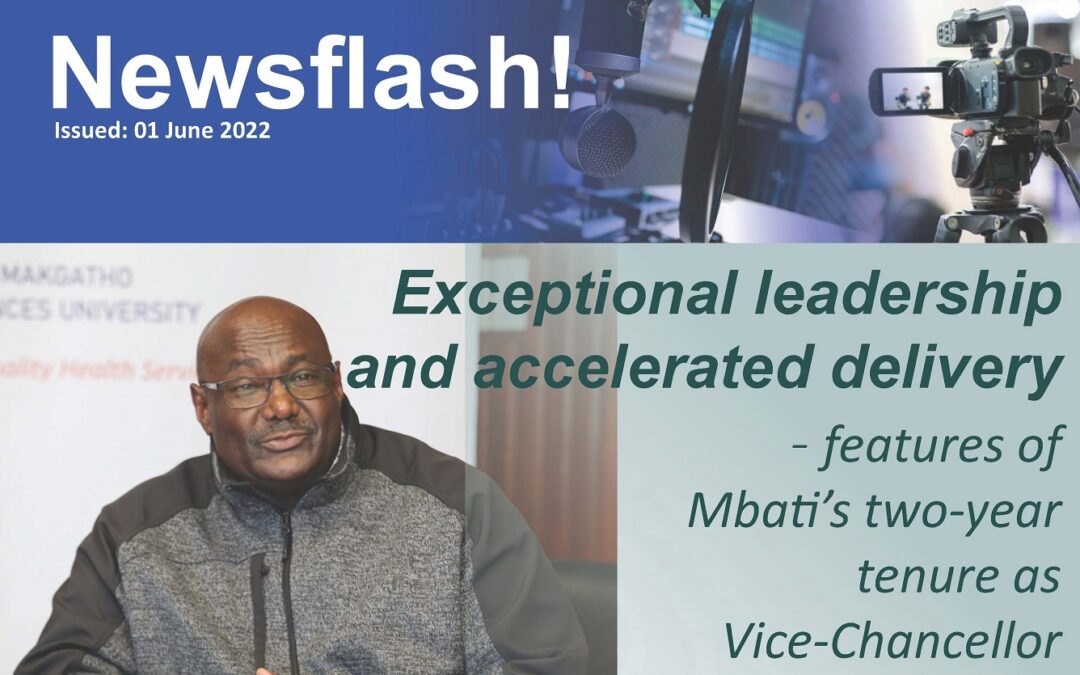
Exceptional leadership and accelerated delivery – features of Mbati’s two-year tenure as Vice-Chancellor of SMU
This week marks the second year since Prof Peter Mbati took the reins at SMU as Vice-Chancellor. A cursory look at the past two years offers a picture of hope for this institution. Armed with a 5-year strategic plan, the Vice-Chancellor has been hands on to ensure that this fledgling University deals with its challenges and progresses to realize its full potential in the higher education space.
Under Prof Mbati’s leadership, SMU has ramped up the delivery of new infrastructure projects on campus and the revitalization of aging ones including the premium 2,000 bed student accommodation facility, the 800 bed student accommodation project, the bulk water project, campus perimeter wall, installation of high mast lights, CCTV cameras and a drone to complement the campus security efforts, renewal of various sporting facilities, staff and students cafeteria, building of pharmacy labs, maximization of library space and modernization of the facility, forklift upgrade of the campus ICT infrastructure, upgrades and maintenance of student residences, and tarring of the campus ring road, among many other planned and ongoing projects.
Some of the projects have been completed while others are at an advanced stage of accomplishment.
Most notably, the centrality of the academic enterprise is firmly on the Agenda of Management and key strategies are being introduced and implemented to ensure the University realizes its key strategic objectives in relation to the core business.
The Vice-Chancellor is also on a crusade to build and maintain relations with key stakeholders internally and externally to ensure they play a meaningful role in building a successful SMU. Moreover, the University has also recently filled in key positions including that of the Chief Operations Officer and several Directors to set the institution on a new trajectory of success.
Download Full Article here
by Lorato | Jan 12, 2022 | Accolades and Achievements, All News, SMU Media
- Sefako Makgatho Health Sciences University (SMU) is the only Health Sciences University in South Africa established in 2014. The University has five Schools offering a range of academic programmes:
a. School of Health Care Sciences
b. School of Medicine
c. School of Pharmacy
d. School of Oral Health Sciences
e. School of Science and Technology
- The University has over 80 academic programmes on offer from undergraduate to postgraduate study levels. Plans are also afoot to increase the number of qualifications aligned to the comprehensive character of the University. This will enable the University over time to offer Higher Certificate, Diplomas, Advanced Diplomas, Bachelors, Postgraduate Diplomas, Honours, Masters and Doctoral degrees.
- Although a Health Sciences focussed institution, the University also boasts one (1) DST/NRF Chair and over ten (10) National Research Foundation rated researchers.
- In terms of student profile, the University has enrolled over 6600 students in 2021, from a low base of just over 4000 students in 2015. The new business model approved by the Council and supported by the Department of Higher Education and Training (DHET) will see the total number of enrolled students increasing significantly to over 10 000 by 2030.
- In order to improve the governance and administration of the University, the Council of the University has approved for implementation over fifty (50) new policies, procedures and protocols since 2015. The approval of these policies, procedures and protocols have laid a solid foundation for effective institutional governance and administration of the University.
- Infrastructure planning is key in ensuring that University assets are expanded in line with student growth and that the existing infrastructure is preserved in line with the Maintenance regime that is in line with best practice. To this end, the Council has approved for implementation, the following:
6.1 2000-bed student residence, the construction of which began in 2021
6.2 Renovation of the student and staff cafeteria, the construction of which began in 2021
6.3 Commercialisation Strategy, with a view to increasing the University’s third stream income
6.4 Infrastructure maintenance strategy and plan
6.5 800-bed student residence, the funding for which was ultimately approved by the Minister of Higher Education, Science and Innovation
6.6 Library Upgrade Project, the funding for which was eventually approved by the Minister of Higher Education, Science and Innovation
6.7 2021 – 2025 Strategic Plan of the University
6.8 Actual graduate headcount increased from 1186 in 2019 to 1337 in 2020, a remarkable increase by 12.7%, and exceeding the 2020 target by 12%. The undergraduate degree credit success rate increased from 86.7% in 2019 to 95.7% in 2020 against the set target of 86%. The total degree credit success rate was 84.9% against a target of 76%.
6.9 Of the total permanent instructional/research staff, 302 (47.4%) hold a masters qualification and 130 (20.4%) have a doctorate as highest qualification, indicating an increase by 6.6% for instructional/research staff with doctoral degree qualification.
6.10 Number of research publication output units increased from 106.7 in 2019 to 174.6 in 2020, translating to an increase by 63.6% and exceeding the 2020 target by 35%. The number of research masters units decreased from 66 in 2019 to 54.5 in 2020 with research doctoral units increasing from 15 in 2019 to 36 in 2020, a remarkable increase by 140%. In total, research output units increased from 192.2 in 2019 to 265.05 in 2020, an increase by 37.9%.
6.11 SMU’s Department of General Surgery is the first in South Africa to make use of the Hot Axios Stent Technique (HAST) to relieve a patient suffering from jaundice, due to an obstruction in his bile duct. Although this technique has been in use for several years overseas, it was used for the first time to relieve bile duct obstruction in both the private and public sectors, in South Africa.
6.12 Paediatric Oncology Unit received Health Professions Council of South Africa (HPCSA) accreditation. The Dr George Mukhari Academic Hospital (DGHAH) and SMU were accredited by the HPCSA with a subspecialty training unit of paediatric oncology. The unit hopes to offer radiotherapy services and also conduct a lot of research in the future.
6.13 The university made history when it broke into uniRanks’s top 200 popular and recognized institutions of higher learning in Africa. SMU is ranked number 184 out of about 1300 institutions in the African continent.
6.14 Residences – SMU strives to provide living and learning communities in a home away from home environment, directed at exploring and exploiting our students’ full potential. The university provides 80% of its total registered students with accommodation in on- and off-campus facilities. We upgraded our firewall and Wi-Fi connectivity in the residences and successfully migrated our hosted learning management system to the cloud which enhanced the ability to cope with the large traffic occasioned by the increase in online teaching and learning. We also had growth in our broad band from a mere 100Mbps to 10Gbps.
6.15 Following an extensive audit of its network infrastructure, the university has embarked on an ambitious forklift upgrade of the entire ICT network and infrastructure, which would guide its future information and technology roll-out. This major investment would modernize and secure our network, and server and provide a new fibre-optic cable infrastructure. This will provide adequate capacity and resilience where possible, and sufficient connectivity on campus, both wired and for pervasive Wi-Fi to allow students and staff to work flexibly on a variety of devices, including their own.
6.16 The University has received unmodified audit opinion in 2018, 2019 and 2020 financial years, a testimony that its financial position is sound.
by Lorato | Nov 8, 2021 | Media Statements, statements
Media Statement
Date: 08 November 2021
For Immediate Release
In the last few days, Management received a set of demands from students residing at University-leased off campus residences, particularly TVL, The Heights and Drie Lillies. The main demand raised is that students should continue to reside at these facilities whose contract with the University expires at the end of 2021.
Students have decided to continue with protest action despite several engagements held with them where the University’s position on the matter was reiterated. Management remains of the firm view that the demand that students be allowed to stay in the University-leased student accommodation facilities beyond the expiry of the signed agreements between the University and these providers, who are not on the approved Panel of Service Providers, cannot be acceded to. What the students want Management to do is to essentially annul its decision that has been approved by Council.
Sadly, the continued student protest will collapse the 2021 academic calendar which has previously been revised again due to staff and student protests on campus earlier in the year. These protests seriously negatively impact on the operations of the University and will affect productivity and the performance of the institution as staff members are also prevented from accessing their offices.
The University rules prohibit any protestors from barricading university entrances. The University Management therefore calls upon protesting students not to prevent those students who want to proceed with their academic studies or staff members who wish to access their offices.
Students are similarly requested to abide by the decision taken by the University as no further extensions of the residences in question would be made as doing so would be illegal and exposes the University to litigation. The University is not in a position to act outside the structures of its Supply Chain Management policies.
Issued by the Communication and Marketing
For more details, please contact Phaladi Seakgwe, email address phaladi.seakgwe@smu.ac.za
Cell: 0790751673
Download Media Statement
by Kegorapetse | Apr 30, 2021
Student Residences Home » Search Results for "" (Page 202) SERVICES RENDERED Proof of residence for students Washing machines and tumble dyers Kitchen and stove Cleaning services Issuing of tissues every month Maintenance (renovations, replacement of...