
by Lorato | May 18, 2023 | Accolades and Achievements, All News, Research, SMU Media, Student Media
Sefako Makgatho Health Sciences University’s renewed strategic intent to be a leader in health education, health services, research and innovation that contributes to the advancement of human health, is contingent on leveraging on partnerships, linkages and internationalization.
In support of this objective, coupled with a focus on expanding the University’s global footprint, the Office of the Vice-Chancellor invited the People’s Republic of China’s South African Embassy representatives to visit the University in July 2022. The Chinese delegation to SMU was led by Mr. Long SHEN and the second Secretary for Science and Technology, Mr. Wei XIE. It was during these initial discussions that the highly ranked Wenzhou Medical University (WMU) was identified as the partner of choice for collaboration with SMU.
The initial engagements with WMU, which commenced in July 2022, led to the introduction of an Ophthalmology and Optometry Advanced training programme for staff and students. As part of this programme, that took place in October 2022, 15 experienced academics from both institutions had an opportunity to share their insights during the lectures, with over 30 South African clinicians having attended the programme.
The successful hosting of this specialist training programme highlighted the compatibility of the two institutions as dedicated health sciences universities, and the mutually beneficial skills and knowledge that could be shared between them. Against the backdrop of these initial engagements, on 10 May 2023 the President of WMU, Prof. Lyu Yijun and the SMU Vice Chancellor, Prof. Peter Mbati signed an MoU to formalize collaboration between the two sister universities.
Whilst recognizing that this MoU sets out a broad frame-work on matters that both institutions intend to pursue and collaborate their efforts, the following are the main objectives of the MoU:
- To provide a broad framework within which the two institutions can develop and undertake collaborative projects in areas of common interests in, amongst others, research, teaching and learning or other mutually agreed initiatives.
- To promote cooperation in teaching, learning and research through an international exchange of students and staff.
In his address at the signing of the MoU, the WMU Chancellor, Prof. Lyu Yijun reflected on the initial engagements between the two institutions pointing to the fact that the success of the Ophthalmology and Optometry Advanced training programme was a good start to the collaboration, which led to the signing of the MoU. He further highlighted the following key aspects:
- The Wenzhou Medical University, jointly established by the Ministry of Education, the National Health Commission and Zhejiang Provincial Government, is one of the Priority Development Universities in the Zhejiang Province. In the past three years, the University has steadily developed and improved on the quality of its educational provision. Their nine disciplines have entered the top 1% of ESI global rankings. The University has also established national key laboratories, National Engineering Research Center and several high-tech innovation platforms; recruiting high-level talents such as academicians, “outstanding youth”, and Yangtze River scholars. WMU is among the top 100 universities in China in the Wushulian domestic University ranking, and ranks among the top 8 medical universities in the 2022 Shanghai Ranking Consultancy. With 5 affiliated hospitals, WMU enjoys abundant clinical resources, with the annual outpatient number exceeding 10 million.
- The signing of the MoU marks a new page of cooperation between WMU and SMU. Wenzhou Medical University will fully leverage our strength in medical education, research and healthcare to work closely with SMU and carry out multi-level collaboration in student and faculty exchange, joint research and publication, academic exchange and etc., setting an excellent example of China-South Africa collaboration in medicine and education as well as promoting the development of medicine in the two countries.
In his response, the SMU Vice Chancellor, Prof. Peter Mbati expressed appreciation for the Wenzhou Medical University’s willingness to enter into a partnership with SMU and further highlighted the following:
- The two countries are friendly allies who cooperate, economically, as part of BRICS. This cooperation also lends itself to opportunities for collaboration in other sectors, such as higher education.
- As the only purely health sciences university in Southern Africa, fit-for-purpose and mutually beneficial partnerships are important to SMU academically, but also for expanding our University’s global footprint. In this context, this partnership between SMU and WMU will allow for knowledge and skills exchange, student and staff mobility, training of academics as well as executive management, collaborative research opportunities and virtual student and staff exchange.
- Being a niche university, research and innovation is extremely important for SMU which conducts research housed in various units: the Diarrhoeal Pathogens Research Unit, a designated World Health Organisation Regional Rotavirus Reference Laboratory and Collaborating Centre; the South African Vaccination and Immunisation Centre; MeCRU Clinical Research Unit; the HPV and STIs Training Centre for Africa; the SMU Minimal Invasive Surgery Unit; the HIV-1 Resistance and Molecular Lab; the Electron Microscope Unit; the HIV and Hepatitis Research Unit, who recently added a new niche area in the field of genetic diversity of coronaviruses; and the Centre for Entrepreneurship Rapid Incubation. Prof. Mbati concluded his remarks by stating that SMU views this partnership with WMU as a mutually beneficial collaboration which enables the sharing of knowledge between the two institutions, leveraging on each institution’s strength.
In support of the signing of the MoU, Dr Prudence Makhura, Director: International Grants and Collaborative Initiatives at the National Research Foundation (NRF) stated that…
“The National Research Foundation (NRF) is in support of the MoU between Sefako Makgatho Health Sciences University and the Wenzhou Medical University in China, especially, given the importance of China to South Africa, not only on a bilateral level but also as a member of BRICS. Health research is one of our strategic thematic research areas with our Chinese partners. We therefore, look forward to receiving research proposals between the two institutions when the SA-China Research Call (and the BRICS multilateral call) opens later in the year”.
by Lorato | May 17, 2023 | Accolades and Achievements, Research, Student Media
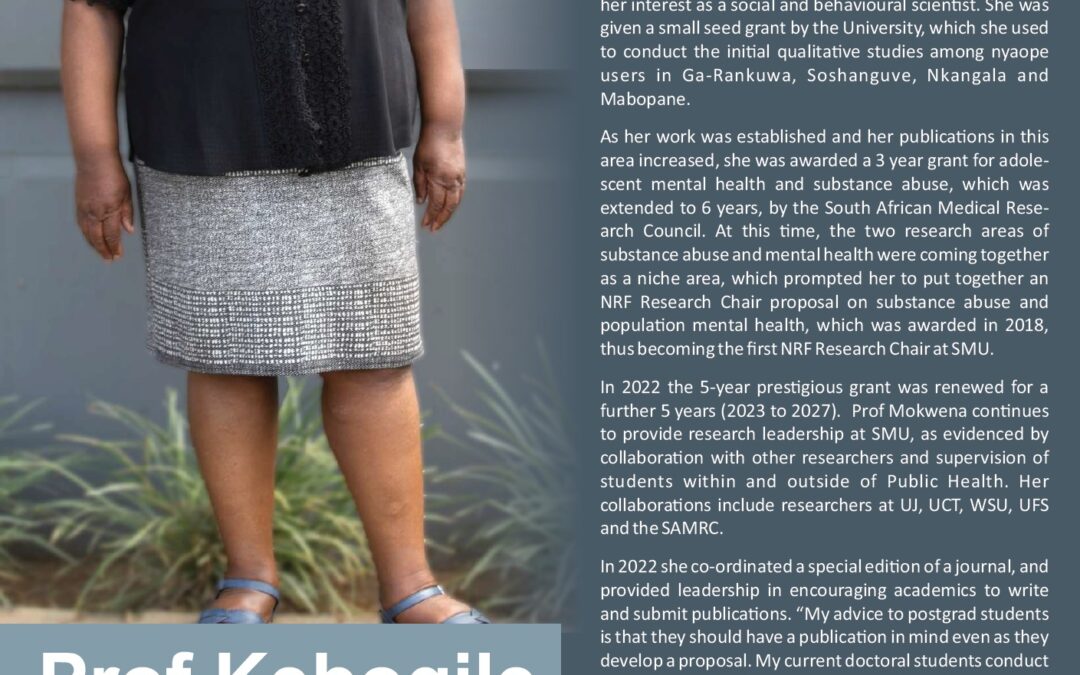
Prof Mokwena is the first and only NRF Research Chair at SMU, and her research portfolio hasshone brighter in the past few years. She obtained the MSc (Physiotherapy) from MEDUNSA and later received a scholarship for doctoral studies in the USA, where she obtained the Doctor of Education (Health Education Administration) degree from the University of South Carolina in Columbia. She came back home and was appointed the founding HOD of the Department of Social and Behavioural Health Sciences within the then National School of Public Health.
Her interest in mental health was triggered by an MPH student she supervised, who was screening for postnatal depression in Tshwane. She later developed a proposal in that area and was later awarded a grant by the South African Medical Research Council which she used to expand her research in postnatal depression in various provinces. Towards the end of 2009, nyaope (a concoction of various substances) use was getting the interest of media publications, which caught her attention as well as her interest as a social and behavioural scientist. She was given a small seed grant by the University, which she used to conduct the initial qualitative studies among nyaope users in Ga-Rankuwa, Soshanguve, Nkangala and Mabopane.
As her work was established and her publications in this area increased, she was awarded a 3 year grant for adolescent mental health and substance abuse, which was extended to 6 years, by the South African Medical Research Council. At this time, the two research areas of substance abuse and mental health were coming together as a niche area, which prompted her to put together an NRF Research Chair proposal on substance abuse and population mental health, which was awarded in 2018, thus becoming the first NRF Research Chair at SMU. In 2022 the 5-year prestigious grant was renewed for a further 5 years (2023 to 2027). Prof Mokwena continues to provide research leadership at SMU, as evidenced by collaboration with other researchers and supervision of students within and outside of Public Health. Her collaborations include researchers at UJ, UCT, WSU, UFS and the SAMRC.
In 2022 she co-ordinated a special edition of a journal, and provided leadership in encouraging academics to write and submit publications. “My advice to postgrad students is that they should have a publication in mind even as they develop a proposal. My current doctoral students conduct studies in various focus areas of mental health, including bullying in schools, parental stress of people who are raising children with disabilities, childhood trauma and burden of care of family caregivers of mental health care users”, said Prof Mokwena. Her current major research projects include several clinical studies on the health impact of nyaope, undiagnosed depression and anxiety among groups of people, and a national study to screen for postnatal depression among clinic attendees. She has built a strong research team which she credits with being integral to her research success.
She received 3 research excellence awards from SMU at the end of the 2022 academic year and has now added a C2 rating by the NRF to her recent achievements.

by Lorato | May 9, 2023 | Accolades and Achievements, Research, Student Media
Prof Larry Obi holds a terminal PhD degree in Medical Microbiology, obtained at the College of Medicine, University of Lagos, Nigeria. He has taught in different Universities in Nigeria, Zimbabwe, South Africa and served as visiting Professor to the Medical School, Makerere University, Uganda; Medical School, University of Malawi, Malawi and Medical School, Tohoku University, Sendai, Japan.
Throughout his career, he served at all levels of academia: Head of Department of Microbiology in two Nigerian Universities; founding Head of Department of Microbiology, University of Venda; Deputy Dean, School of Natural Sciences and Mathematics and later Acting Executive Dean, Faculty of Natural, Environmental and Integrated Studies, University of Venda; Director, School of Agriculture and Life Sciences, University of South Africa. He also served as Deputy Vice Chancellor, Academic Affairs and Research in two South African Universities, Walter Sisulu University and the University of Fort Hare. He, at various times, acted as Vice Chancellor in both Universities.
Prof Obi has supervised several postgraduate students, presented scientific papers at local and international conferences and published extensively in numerous journals with more than 100 publications to his name. He served on the board of the South African Council for Natural Scientific Professions (SACNASP) and the Board of the National Health Laboratory Service (NHLS). He is a member of the Specialist Committee of the National Research Foundation Rating Panel for Health Sciences, Specialist Committee for the FLAIR International Post-doctoral Fellowship Programme under the aegis of the African Academy of Sciences, Kenya and the Royal Society, United Kingdom. He is also a member of the Membership Advisory Committee (MAC), Health Sciences, Life Sciences and Agricultural Sciences of the Academy of Science of South Africa.
His academic pedigree is further exemplified by being the Principal and Country Investigator of a project on Family Planning in the context of HIV/AIDS, Principal Investigator of the Socio-economic impact of HIV/AIDS in South Africa, funded by the Australian Agency for International Development (AuSAID), World Health Organization (WHO) Expert Committee Member on Campylobacters and Campylobacteriosis, among others. Principal Researcher. Pathogenic and Molecular profiles of Aeromonas, Funded by the National Research Foundation, 2008 -2011.
He also worked on numerous projects such as the following:
- Principal Researcher: Key Medico-epidemiological issues in tackling the scourge of HIV/AIDS. Collaborative Project with Tohoku University, Japan, Funded by the National Research Foundation (NRF), South Africa and the Japanese Society for the Promotion of Science. 2009.
- Principal Researcher: Microbiology of Cosmetic and Medicinal Clays. Funded by Walter Sisulu University, 2009.
- Principal Researcher: Antibacterial activities of medicinal plants against selected pathogenic bacteria. Funded by Walter Sisulu University, 2009.
- Co-Principal Researcher: The possible role of Osteopontin and South African Medicinal plants in the management of HIV/AIDS ARV naïve patients and those on HAART. Collaborative Project with Tohoku University, Japan. Funded by the National Research Foundation, South Africa. 2010.
- Principal Researcher: Bactericidal Activities of Honey and propolis against enter pathogenic bacteria isolated from food and water samples in Limpopo and Eastern Cape Provinces. Funded by Walter Sisulu University, Mthatha, South Africa, 2010.
- Principal Researcher: Molecular landscape, antibiograms and antibacterial activities of selected medicinal plants against some enteric pathogens. Funded by the Medical Research Council (MRC) of South Africa, 2010.
- Principal Researcher: National Lotteries Research Grant Award, 2011.
- Principal Researcher: National Research Foundation Research Grant Award on Community Engagement, 2011.
- Principal Researcher: National Research Foundation (NRF) Grant on a Collaborative Project between South Africa and Namibia, 2012-2014.
- Principal Researcher: National Research Foundation (NRF) Grant on Incentives for Rated Researchers 2012-2016.
- Principal Researcher: Competitive Programme for Rated Researchers research Grant, 2015-2017.
- Principal Researcher: Indigenous Knowledge Research Grant, National Research Foundation, 2016-2018.

by Lorato | May 3, 2023 | Accolades and Achievements, Research, Student Media
Prof Mapaseka Seheri has been with SMU for sixteen (16) years serving in the Department of Virology and Research and Innovation Directorate and believes that this has provided her with a broad knowledge in research excellence and impact, teaching and learning, as well as the ability to successfully lead research enterprise and academic groups. “My current role as the Research and Innovation Director is to actively support the DVC Academic and Research in achieving the University Research and Innovation strategic objectives and to accelerate the following; 1) promote strategic collaborations and partnerships; 2)
promote interdisciplinary research and attract external research funding; 3) improve and enhance high quality research output with high impact; 4) promote and strengthen existing and emerging research focus areas; 5) attract postgraduate students and postdoctoral research fellows; 6) increase research capacity, attract and strengthen research teams. I am also the Director of the Diarrhoeal Pathogens Research Unit(DPRU)/WHO Rotavirus Regional Reference Laboratory (WHO RRL)/WHO collaboration Centre.
Prof Seheri’s research focus area addresses childhood diarrhoeal diseases nationally and regionally, prioritising the health of women and children in order to achieve the United Nations Sustainable Development Goals (SDGs), that would reduce maternal, neonatal and under-five mortality by 50% in the African Region. Diarrhoeal disease and pneumonia remain the leading causes of death in children < 5 years of age in sub-Saharan Africa.
She is a recognised scholar, leader and has extensive experience in molecular virology, disease surveillance systems, molecular epidemiology, interaction between host and virus, viral diversity, genetics and evolution, whole genome sequencing and bioinformatics for rotavirus and norovirus as well as other diarrhoeal pathogens, gut microbiome and metagenomics research, with Google Scholar Citations: 1690, h-index (Google scholar): 24 and Scopus h Index :21. Prof Seheri continued to publish at an international level of excellence in high quality journals and has more than 60 peer – reviewed articles to her name. She was awarded C1 NRF rating and has presented more than 100 papers at scientific conferences both locally and internationally. The research conducted supports the African Rotavirus Surveillance Network, Global Rotavirus Surveillance Network, Global Paediatric Diarrhoeal Surveillance and Global Paediatric Norovirus Surveillance Network.
Prof Seheri has trained, mentored and supervised 35 postgraduate students (PhD, MSc and Hons) and 4 Postdoctoral research fellows, who have successfully completed their studies. In addition, she currently has, 2 PhD, 5 MSc and 2 Hons students registered under her supervision. “I have also served as manuscript reviewer and external examiner for postgraduate students’ dissertations/thesis for various institutions locally and internationally such as; Technical University of Kenya, University of Venda, University of Pretoria, University of KwaZulu-Natal and University of North West, Mafikeng Campus. “As a collaborative effort jointly with WHO and partners, we successfully organised fourteen AFR RSN Inter-Country Training Workshops, and I have trained 42 scientists/ technologists from 29 African countries. I have earned local and international recognition in the field of diarrhoeal diseases and rotavirus, where I have made valuable contribution in the introduction of rotavirus vaccine in the African continent, pioneered the whole genome sequencing in African continent and my proven ability to successfully leading research and academic groups, by hosting the Rotavirus Regional Reference Laboratory – South Africa (RRL – SA), member of the African Rotavirus Surveillance Network and recently leading the Diarrhoeal Diseases and Vaccine Research WHO Collaborating Centre”, she said.
Her current network research collaborations span National, Regional, International Research Institutions, Academic Institutions and Ministries of Health of more than 27 African countries supported by research articles produced. “I am currently serving at the highest level local, national, regional and international structures and received a research fellowship with the University of Ghent, Belgium and a visiting research fellow at Centres for Disease Control and Prevention/National Centre for immunisation and Respiratory Diseases (Atlanta)”, added Prof Seheri.
She was appointed for the 2nd term by the Minister of Health to the National Authority for Containment committee on poliovirus eradication (2021-2025) and a member of various committees at SMU.

by Lorato | May 3, 2023 | Accolades and Achievements, All News, Research, SMU Media, Student Media
Sefako Makgatho Health Sciences University (SMU) is proud of its seven (7) academics and researchers who have recently been awarded ratings by the National Research Foundation (NRF). The seven are Professor Kebogile Mokwena, Prof H Kluyts, Prof, Mapaseka Seheri, Prof Lawrence Obi, Dr Samantha Govender, Dr M Mkolo and Dr Gauta Matlou. The NRF rating system is a key driver in the NRF’s aim to build a globally competitive science system in South Africa. It is a valuable tool for benchmarking the quality of our researchers against the best in the world. NRF ratings are allocated based on a researcher’s recent research outputs and impact as perceived by international peer reviewers. The rating system encourages researchers to publish high quality outputs in high impact journals/outlets. Rated researchers as supervisors will impart cutting-edge skills to the next generation of researchers.
The Research and Innovation Directorate through the leadership of Prof Mapaseka Seheri provides support to academic researchers throughout the application process which includes but not limited to: Information sessions, step-by-step guide on how to complete the Rating application form and one-on-one meetings with potential applicants.
The rating of individuals is based primarily on the quality and impact of their research outputs over the past eight years, taking into consideration the evaluation made by local and international peers. It identifies researchers who count among the leaders in their fields of expertise and gives recognition to those who constantly produce high quality research outputs. “Several South African universities use the outcomes of the NRF evaluation and rating process to position themselves as research-intensive institutions, while others provide incentives for their staff members to acquire and maintain a rating and give special recognition to top-rated researchers so is SMU”, says SMU Director of Research and Innovation Professor Mapaseka Seheri.
The ratings that are awarded fall within the following categories:
• A – Leading international researchers
• B – Internationally acclaimed researchers
• C – Established researchers
• P – Prestigious Awards
• Y – Promising young researcher
While it is also important to note that NRF provides incentive funding to researchers once they receive their rating, SMU also does provide incentives and acknowledge rated researchers during the Annual Vice Chancellor’s Excellence awards.
Detailed information on NRF Rating can be obtained at: https://www.nrf.ac.za/rating/
For institutional support, guidance and information please visit the Research and Innovation Directorate at 5th Floor Clinical Pathology Building or contact Prof LM Seheri (mapaseka.seheri@smu.ac.za)

by Lorato | Mar 23, 2023 | Accolades and Achievements, All News, SMU Media, Student Media
Professor Nathaniel Mofolo heeded the call in 2017 and enrolled for a professional Doctorate in Business Administration in Higher Education Management offered by the University of Bath in the United Kingdom (UK). The University of Bath has established itself as one of the top 10 UK universities with a reputation for research and teaching excellence.
This was a collaborative partnership with the Nelson Mandela University’s (NMU) Teaching Development Grant funding from the DHET to implement the Future Leaders Initiative programme. The programme aimed to provide high-level development opportunities for professional, administrative, management and support staff involved in leading and managing sections or divisions linked to the academic project in universities. It also aimed at enhancing the general quality of teaching, student learning and success.
Prof Mofolo was part of the second cohort of 27 senior professional staff who started in 2017. The professional Doctorate is an innovative, research-based programme designed to meet the needs of senior professional staff. It is offered on a part-time basis, through a blended mode of delivery, with four 8-day residentials (contact sessions) in the first two years of the programme. The first and last residentials were held at NMU and the other two at the University of Bath. After the two years of course work, a doctoral research study is undertaken. This means that the programme, generally, takes 4 to 8 years to complete. Professor Mofolo completed his Doctorate in 2022; and he is the third to complete in his class. He will be graduating on the 19th July 2023 in the UK.
The title of his thesis was: Evaluation of the implementation and assessment of AfriMEDS physician competency framework in an undergraduate medical programme: A South African mixed- methods case study.
The study focused on the evaluation of the implementation and assessment of milestones achieved in entrenching the AfriMEDS physician competency framework in an under- graduate medical programme in South Africa. The study concluded by showing that a framework, guidelines and benchmarked assessment tools are needed to infuse the AfriMEDS framework to transform an undergraduate medical curriculum. Furthermore, the developed guide- lines, when implemented, will lead to the improvement of the quality of medical students.
SMU Vice-Chancellor, Prof. Peter Mbati, on behalf of the university congratulates Prof. Mofolo for this monumental achievement.
The Dean of the School of Medicine at SMU Prof Nathaniel Mofolo attains a Doctorate in Business Administration (DBA) from a UK based University
File size: 4.50 MB
Created: 23-03-2023
Updated: 23-03-2023
Hits: 321
