by Lorato | Jan 20, 2022 | All News, SMU Media, Student Media
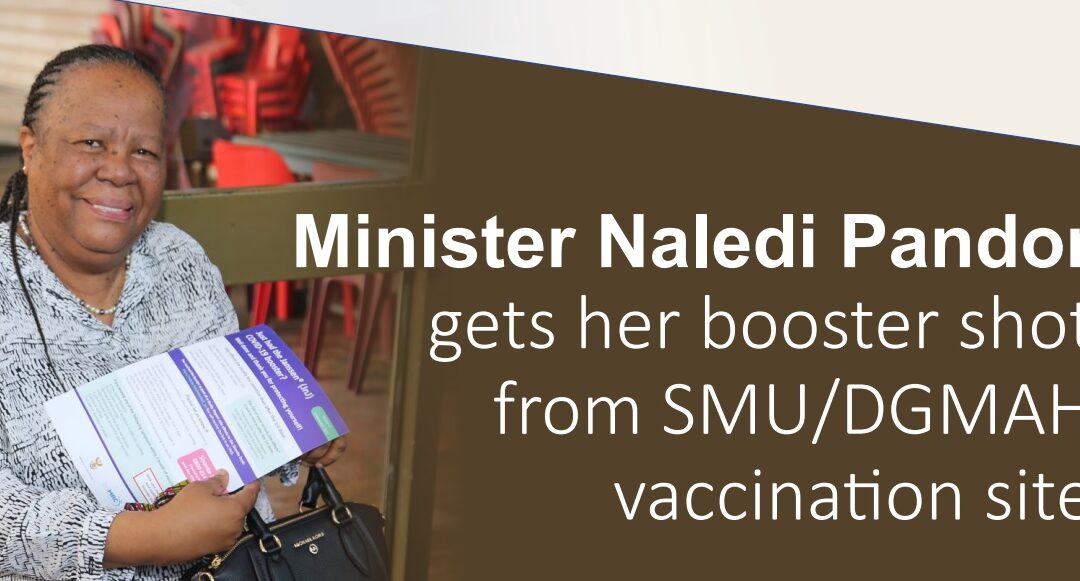
International Relations and Cooperation Minister Dr Naledi Pandor visited the SMU/DGMAH vaccination site today 20 January 2022 to take her booster shot.
Speaking to SMU publications after receiving the shot, Minister Pandor congratulated the University and the hospital for running a properly arranged and good site for vaccination. “I think proper arrangements have been made for the site, it is well ventilated and professionally run with great staff members”, said the Minister.
Minister Pandor said she needed to take a booster shot of the Johnson & Johnson vaccine and heard that it is available at the SMU/DGMAH vaccination site. She was also pleased that the site offers both the Pfizer as well as the Johnson &Johnson vaccines.
She challenged members of society to go and voluntarily vaccinate in their numbers to ensure that everyone is protected. “If I have been so disciplined and vaccinated with the right number of doses, every person in our country should make themselves voluntarily available to be vaccinated. Each of us have a responsibility to protect ourselves, our families and the rest of society. Being vaccinated is to perform your patriotic duty and not just to the South African population but to the global population. We are a global community confronted by a global pandemic”, concluded Minister Pandor.
SMU Vice-Chancellor Professor Peter Mbati met with the Minister and thanked her for leading by example as well as choosing to vaccinate at the SMU/DGMAH site. Prof Mbati called upon members of the community to emulate the Minister to come and vaccinate at the site. Vaccines for Covid-19 have been shown to reduce severe disease and mortality and are lifesaving. Being vaccinated will protect people from severe illness and/or death. Vaccination will reduce but not prevent mild to moderate illness.
As COVID-19 variants emerge, research has shown that protection against COVID-19 is related to antibody levels. Booster vaccines are a reliable and safe way of increasing antibody levels and currently recommended for all individuals above 18 years by the National Department of Health.
The public is reminded that the following can be done at the SMU/DGMAH vaccination site:
- Pfizer booster dose is available after 6 months (180 days) of the second dose
- J & J booster dose is available after two months (60 days) of the first dose
- Families are welcome to bring children from 12-17 years for vaccination – those teenagers who have received their first dose of Pfizer, can have a second dose 42 days after the first jab as well.
The vaccination site is operational between Monday and Friday from 8:00 am to 15h00 pm.
by Lorato | Dec 24, 2021 | All News, SMU Media
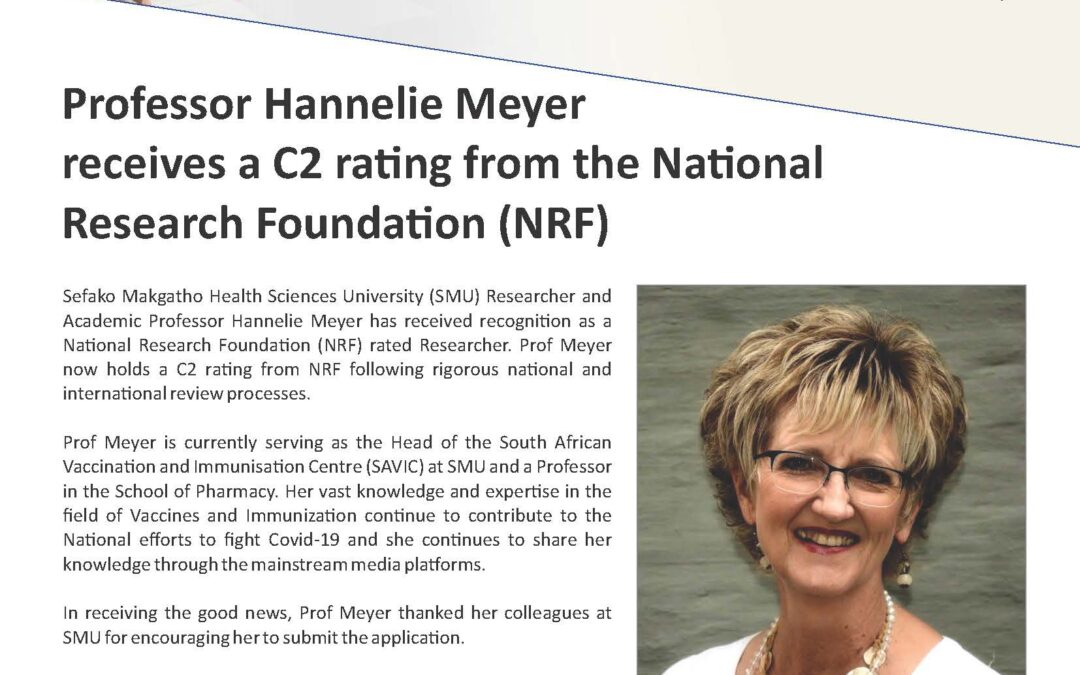
1. Congratulations on attaining a C2 rating Prof, how do you feel about it and did you expect to make it?
I am very grateful and also excited about the news of having received a C2 rating from the NRF. When you apply for an NRF rating, you have to be confident that you will receive a rating, because if you do not receive a rating, then there is a waiting period before you are allowed to apply again. I anticipated a C3 rating, so receiving a C2 rating was really a bonus for me.
2. Take us through the process this went through until you were eventually given a rating by NRF?
The NRF rating process is very lengthy and rigorous, taking approximately a year to complete, including 4-6 external expert reviews and final discussion by an assessment panel. The rating is based on research output and impact over the past eight years, as perceived by national and international peer reviewers, with the quality of your research benchmarked against researchers at a national and international level. The application itself is very detailed and requires you to use critical thinking and apply your mind. It is not something that can be done overnight! In preparation for applying for an NRF rating, you have to ensure that you consistently publish high quality research output and in high impact journals, over a period of at least eight years. Establishing an academic profile takes years, hence you need to have a main focus area of research, with long- and short-term research objectives to guide your own research, post-graduate student research and collaborations. I also strongly believe in collaboration, not only with colleagues at our own institution, nationally and internationally, but also with people in practice, where you actually do your research. The more you collaborate, the more you learn and progress. Helen Keller’s powerful quote has certainly stood the test of time for me, “Alone we can do so little; together we can do so much”.
3. What does it mean for you as a researcher?
As a researcher with a C2 rating it means that you are recognised as an established researcher with a sustained record of productivity in your field of expertise, as recognised by your peers, and that you engage with and are recognised by the international science community. Apart from recognition, acquiring an NRF rating also means that this rating must be
maintained, hence you should maintain your research focus, sustain your research activities and work towards achieving your long-term gaols. An advantage of an NRF rating is that it could be beneficial for you when you apply for grant funding, awards and promotion. In essence, you have to remain committed to your research career, which requires far more than a 40- or 45-hour working week! ”.
4. What is your field of specialty and please give a brief explanation of it?
Since 2014, as an advocate for public health pharmacy, my focus is directed towards the macro-level activities of public health, specifically strengthening the WHO building block of ‘medical products, technologies, and vaccines’, to ensure people have sustained access to, and appropriately use essential medical products, vaccines and technologies that are safe, effective, and of assured quality. The main goals of my research are to strengthen healthcare services, improve public health, and contribute towards reaching the sustainable development goal of good health and well-being, focusing on vaccination as a vital pillar of antimicrobial stewardship and the rational use of medicines.
5. You have been doing a lot of work around vaccines and Covid-19 lately, what is science telling us about vaccination?
History has shown that vaccination is the most significant global health intervention ever, second to clean water, saving millions of lives each year. The main goal of vaccination is to protect people throughout the life course against severe disease and death, thereby reducing suffering and improving quality of life. Over the last 18 months, science has clearly
shown that the COVID-19 vaccines are effective at protecting against severe disease, hospitalisation, and death, caused by the different variants of SARS-CoV-2. Furthermore, science has also shown that COVID-19 vaccines are safe to use and that the benefits of vaccination by far outweigh any possible risks of adverse effects.
6. What can you tell the readers about the recently discovered Omicron variant?
Currently the data about the Omicron variant is still limited and more information should become available in the very near future. Once a new variant is identified, it could impact on how easily the virus spreads (transmissibility), the severity of illness it may cause and the effectiveness of the existing COVID-19 vaccines in protecting against infection, severe disease and death. What we have observed from recent data, especially in the Gauteng Province, is that the rate of new cases of SARS-CoV-2 is much higher compared to previous weeks, with a positivity rate as high as 30-35%, suggesting that Omicron is more transmissible than the Delta variant. Although hospitalisation is also increasing, it is low relative to the community case rate. It also seems as though symptoms are milder, compared to symptoms caused by the Delta variant, with patients testing positive for COVID-19 coincidently when admitted to hospital for another illness or surgical procedure. The duration of hospital stay is much shorter compared to previous waves, with few patients requiring mechanical ventilation. Data has also shown that hospitalisation for severe COVID-19 is mainly amongst unvaccinated people. Preliminary evidence also suggests an increased risk of reinfection amongst people who have already had COVID-19. We have seen a similar situation with the Delta variant where people who were previously infected with the Beta variant were not protected from re-infection with the Delta variant.
7. What is it that people have to do to survive under the difficult circumstances of Covid-19?
At this stage of the pandemic we all have to be very vigilant in a number of ways. The most important action to take is to get vaccinated against COVID-19, as vaccination is the most powerful tool we currently have. Data on the Omicron variant is still limited, but it has already been shown that protection against COVID-19 infection is reduced, because the virus has a mutated spike protein that evades neutralisation by the antibodies that were produced by both previous natural infection and vaccination. However, you are still protected against severe disease and death because, as illustrated by laboratory-based studies, the T-cell response does not appear to be badly affected by the mutations, hence clearing infected cells and preventing viral replication. Recent data released by Discovery, has shown a decrease in protection against infection from 80% against Delta to 33% against Omicron, amongst people vaccinated with two doses of the Pfizer vaccine. Also, protection against severe disease and hospitalisation decreased from 93% against Delta, to 70% against Omicron, with lower protection for the elderly (60-69 years: 67%; 79-79 years: 60%). In addition to vaccination, we have to adhere to public health measures to protect ourselves and those around us. These include wearing a mask, sanitising or washing hands, social distancing, avoiding large crowds and making sure that indoor spaces are well ventilated, including when travelling, by keeping doors and windows open at all times.
8. A lot of people ask questions about variants, it was Delta the other time and now Omicron, what is happening as the virus mutates?
What we know about the new Omicron variant is that it has at least 50 mutations, some of which are concerning. There are more than 30 genetic mutations affecting the spike protein, which is the part of the virus that binds to human cells, allowing it to gain entry. Some of these mutations have also been found in other variants such as the Delta variant, but those variants had far fewer mutations. Viruses will always mutate, and mutations will give rise to new variants. This can be avoided when vaccination coverage is high, because the higher the proportion of vaccinated people, the smaller the chance for the virus to spread and the fewer opportunities for the virus to multiply, mutate and eventually give rise to a new variant.
9. Any further information you wish to share with the readers?
Unfortunately, people who are at highest risk of contracting the new variant are those who are not vaccinated, and who are not adhering to public health measures to protect themselves. Research has shown that natural and vaccine-induced immunity wane over time due to a decrease in neutralising antibodies. Although we are expecting to see more breakthrough infections with the Omicron variant, we expect people to be less infectious because of underlying T-cell responses which are still reserved, hence clearing infected cells and preventing viral replication. Booster doses will be needed in future, as they will provide longer-term protection against serious COVID-19 disease. Recent data on the Delta variant has shown that a third dose of the Pfizer vaccine increased protection against symptomatic SARS-COV-2 infection from 62% to 94%, in people who had previously received the primary series of two doses at least 20 weeks prior to boosting.
10. How would you use your new status as a NRF rated researcher to make a difference in your field?
In light of the COVID-19 pandemic, research in my focus areas of rational medicine use, and vaccination as a pillar for antimicrobial stewardship for AMS, will continue, and specifically address concerns raised about antimicrobial resistance potentially causing the next pandemic. I have been awarded a competitive NRF grant for a project, ‘Leveraging COVID-19 to build confidence in vaccination and promote antimicrobial stewardship in South Africa’. This project includes developing and testing educational interventions to empower healthcare providers to promote vaccination with confidence, thereby increasing public demand for vaccination as a human right. In addition to SMU-based co-investigators and students, I have already established international and national collaborations for this project, including co-investigators from University of Strathclyde, UK; Network for Education and Support in Immunisation, University of Antwerp, Belgium; East Africa Centre for Vaccines and Immunization (ECAVI), Egerton University, Kenya; SA Medical Research Council; University of Cape Town; University of the Witwatersrand; and University of Pretoria. I will continue to use my own enthusiasm for research in public health pharmacy to build capacity and inspire students to disseminate their work to the scientific community. Lastly, I consider the relationship and connection between research, education and community engagement as indispensable. This belief informs my social responsibility to focus my research towards achieving universal healthcare and health for all by 2030, in line with the National Development Plan of South Africa. I therefore always aim to integrate theory and practice, and to instil into students the principles of social responsibility. To achieve this, I have to set an example to my students, provide service and research within my discipline and stay abreast of new developments in practice. I quote Mahatma Gandhi who said, “The best way to find yourself, is to lose yourself in the service of others.”
Interview with Professor Hannelie Meyer on attaining NRF C2 Rating and what science is telling us about Covid-19 vaccination
File size: 6.94 MB
Created: 24-12-2021
Updated: 24-12-2021
Hits: 224
by Lorato | Oct 26, 2021 | Accolades and Achievements, All News, SMU Media, Student Adverts
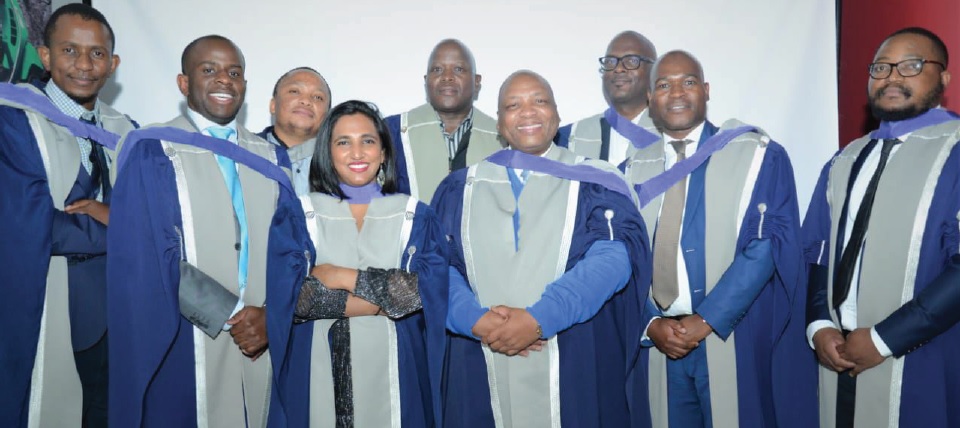
The Department of General Surgery under the guidance of Professor Zacharia Koto who won the SASSiT Swann-Morton Silver Scalpel Award in teaching, has managed to produce a 100% pass rate of surgical specialists at the recent College of Medicine of South Africa (CMSA) exams. The department’s surgical registrars who achieved a 100% pass rate and are actively involved in research are Dr Cecil Pule, Dr Tebo Mosasi, Dr Tumelo Matlala, Dr Lerumo Motla, Dr Thegesh Naidoo, Dr Kennedy Mngoma, Dr Tom Mtshali, and Dr Kenny Mongwe. The sub-speciality fellows are Dr Imraan Sardiwalla (Certificate in Gastroenterology, HPB), Dr Legae Mogase (Certificate in Vascular Surgery), Dr Shumani Makhadi (Certificate in Trauma Surgery).
SMU as a Health Sciences University is on a mission to educate people about health-related matters and make a meaningful contribution especially during these difficult times of Covid-19. According to Prof Koto, SMU is esteemed among Harvard University, Oxford University. In 2019, SMU surgeons got a 100% pass rate during the Fellowship of the College of Surgeons (FCS) exams as well. This excellent spirit of education continues to blossom.
The surgeons, who passed, have knowledge and skills from a pioneer in laparoscopic procedures in the management of trauma patients in South Africa. These graduates are now following in his footsteps as a chief surgeon and a researcher who excelled in laparoscopic aortobifemural bypass graft in South Africa in 2012 without complications.
The Department of Surgery at SMU has fewer financial resources, but despite this it has proven that it can be counted and participate in multiple research projects on par with well-resourced institutions.
The Registrars are now recognising and producing a variety of papers, which are published in different reputable journals as part of their MMED program, and the Department has been participating in many clinical trials that add value to the overall information database. The total number of Registrars who completed FCS (SA), under the leadership of Prof Koto, are 51. He has committed himself to developing and teaching others.